How Lemme Multi calls out the 10-step vitamin routine
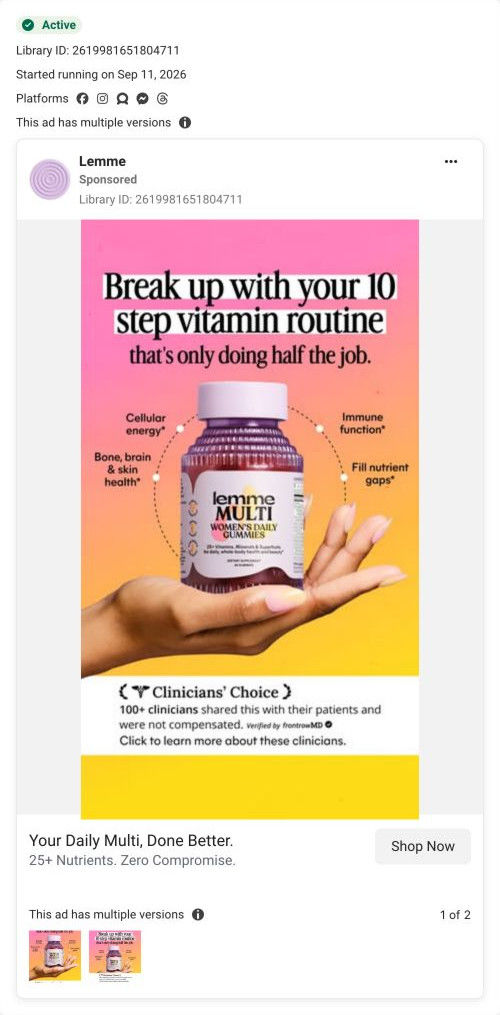
A static image ad for Lemme's Women's Daily Multi that ran on Meta from Sep 11, 2026, in two versions. A hand balances the bottle under a headline telling you to break up with a 10-step vitamin routine that's only doing half the job, with claimed benefit callouts and a Clinicians' Choice band. It links to the Multi landing page.

Captured while scrolling the public page. The page reflects the offer visible on October 20, 2026; it may differ from the original ad.
Your Daily Multi, Done Better.
A concise daily-multivitamin headline uses an advertised nutrient count to introduce the product. The recorded CTA points to the Multi landing URL. Compare the creative with the destination and explore the other ads sharing this route.
- Brand
- Lemme
- Observed offer
- Daily multivitamin with 25+ nutrients advertised
- Creative angle
- Product benefits
- Page type
- Product landing
- Ad format
- Image
- Listed start date
- Sep 11, 2026
- Captured
- Oct 20, 2026
- Library ID
- 2619981651804711
- Destination
- lemmelive.com
Selected for its design and offer structure. Ad performance isn’t available in this collection.
What this ad does well
This is the sharpest Multi headline in the set because it names the habit being replaced. “Break up with your 10 step vitamin routine” paints a picture anyone with a crowded supplement shelf recognizes, and the second line adds that the old routine is only doing half the job. The Clinicians' Choice band at the bottom, saying 100+ clinicians shared it with patients and weren't compensated, verified by frontrowMD, gives the switch a reason to be trusted. The callouts around the bottle keep the claims short.
What's missing
The ad tells you to drop ten steps but never shows them. A row of mismatched bottles crossed out next to the single Lemme bottle would make the switch instant to understand. There's also no price or saving, which matters when the pitch is replacing several products with one. If you make one like this, show the old routine beside yours and add the subscription saving.
Beat by beat
- ImageA hand holds the Multi bottle up from below on a pink-to-yellow gradient, with four callouts on a dotted arc.
The open hand presents the single bottle as the simpler option.
- HeadlineHighlighted text says break up with your 10-step vitamin routine, with a line saying it's only doing half the job.
Naming the habit being replaced gives the viewer a specific reason to switch.
- Proof bandA Clinicians' Choice band says 100+ clinicians shared it with patients and were not compensated, verified by frontrowMD.
The endorsement makes the switch feel recommended rather than just advertised.
- CTAThe link card reads Your Daily Multi, Done Better with the line 25+ Nutrients. Zero Compromise, and a Shop Now button.
The card's nutrient count backs up the claim that one product can replace several.
Where it sends people
The ad sends people to the Multi landing page, a focused product page and one of 4 Lemme ads in the library that go there. The page's versus section, comparing the Lemme bottle with a blank generic bottle and callouts of how much more it contains, is the natural payoff for a switch-from-your-routine ad. The clinician-choice badge in the hero repeats the ad's proof. The page doesn't show a multi-bottle routine being replaced, though, so the break-up idea is carried by the comparison rather than a picture of it.
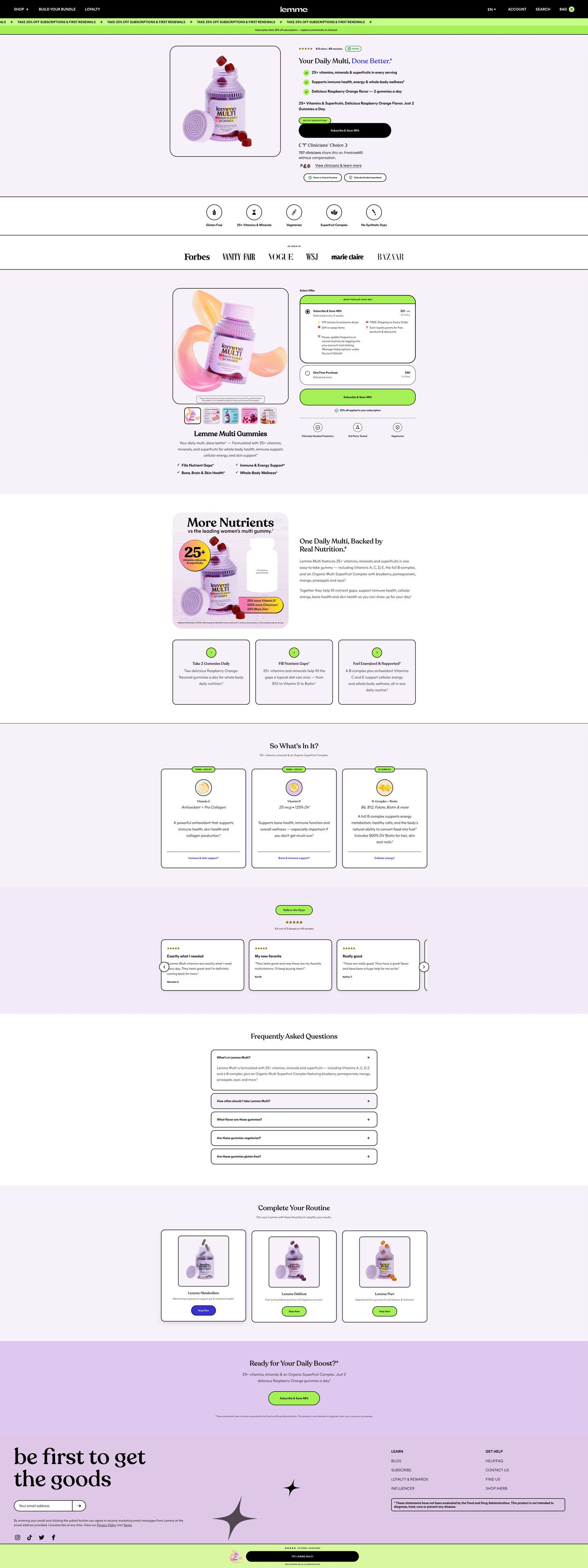
The page it sends people to: How Lemme's Daily Multi page compares itself with a generic bottle
Lemme's landing page for its Women's Daily Multi gummies. It's a single-product lander with a short hero and subscribe button, a subscription-first offer selector, a versus graphic against a generic bottle, nutrient cards and reviews, closing on a daily-boost prompt. 4 Lemme ads in the library send people here, all challenging the reader's current multivitamin.
How the page is built
- 01Header and promo marquee
A black header with shop, bundle and loyalty links and a lime marquee of the subscription discount applied at checkout, answering whether there's a deal and how to get it.
- 02Hero
A product photo beside a star rating, a headline echoing the ads' done-better promise, check bullets, a Subscribe & Save button and a clinician-choice badge, answering what it is and why to trust it.
- 03Attribute strip
Line icons with dietary and formula labels, answering whether it fits your diet.
- 04Press row
An As seen in label over magazine logos, answering whether the brand has outside credibility.
- 05Offer selector
A product gallery with benefit checks beside a pre-selected subscription card with perks and price per delivery and a one-time card, answering how to buy and what you save.
- 06Versus section
An infographic comparing the bottle with a blank generic bottle, two paragraphs and numbered cards on how to take it and what it fills, answering why switch from your current multi.
- 07Nutrient cards
“So what's in it?” cards with a category tag, nutrient name and dose line, answering what's inside and how much.
- 08Review carousel
A “Believe the hype” pill, a rating with count and review cards, answering whether other buyers liked it.
- 09FAQ
A centered stack of accordions, answering the remaining questions.
- 10Cross-sell
“Complete your routine” product cards, offering a way to add to the order.
- 11Closing CTA band
A daily-boost question headline with a Subscribe & Save button, giving a last prompt.
- 12Newsletter, footer and sticky bar
An email signup, links, a disclaimer and a lime sticky bar with rating and a try button, keeping the purchase in reach.
The first fixes we would make
- The versus graphic compares against a blank generic bottle, which is easy to dismiss. Compare against the routine the ads call out (several separate bottles, as in the 10-step headline), so the reader sees their own shelf being replaced.
- The Clinicians' Choice detail in the ads (100+ clinicians, not compensated, verified by frontrowMD) is reduced to a badge on the page. Put that full line beside the badge, so the proof is as specific on the page as it was in the ad.
Read the full breakdown of this page
Three hooks you could test
- Call out the habit you're replacing. “Your supplement shelf doesn't need ten bottles.”
- Turn the benefit into a picture people get in a second. “Ten bottles out, one bottle in.”
- Sell the outcome. “Mornings with one step instead of ten.”
What to borrow for your brand
- Name the exact routine your product replaces, with a number, so the viewer pictures their own shelf.
- Add a second line explaining why the old routine falls short, so the switch has a reason.
- Pair a switch headline with an endorsement band, so the viewer trusts that the swap is worth it.
One of 25 Lemme ads in the Fluid Inspiration Library, captured from the Meta Ad Library on Oct 20, 2026. We record that an ad ran publicly, not how it performed.