

WuffesSponsored
Esc
How Wuffes explained five dog allergy symptoms with a marker drawing
A 39-second Wuffes video on Meta from Sep 18, 2026. A hand draws and circles dog allergy symptoms in red marker, from scratching and paw licking to yeasty ears, hot spots and eye discharge, and the voiceover pairs each with an ingredient. It ends on Wuffes Allergy & Itch Chews and a 90-day risk-free trial, linking to an allergy advertorial.
Wuffes
3 creatives lead here1 / 3


Five reasons for allergy support
The 2-second routine for itch-free comfort
An allergy-and-itch video sends visitors to a five-reason sales story for the matching chew. The destination redirects to the brand’s dedicated campaign domain. Compare the creative with the destination and explore the other ads sharing this route.
- Brand
- Wuffes
- Observed offer
- 25% off + free shipping on the page
- Creative angle
- Problem-led
- Page type
- Advertorial
- Ad format
- Video · 0:39
- Listed start date
- Sep 18, 2026
- Captured
- Oct 19, 2026
- Library ID
- 1087778230506475
- Destination
- try.wuffes.com
Selected for its design and offer structure. Ad performance isn’t available in this collection.
What this ad does well
The hand-drawn format is memorable and easy to follow: each symptom gets its own illustration, circled in red as the voiceover names it, so the viewer watches a lesson build on paper. The structure is a numbered list (five symptoms, five ingredients), which makes a complicated product feel organized and gives owners a symptom to recognize in their own dog. Ending on one chew that, in the ad's words, combines all five is a clean wrap-up. The headline, a 2-second routine, makes daily use sound effortless, and the link description adds the 90-day risk-free trial.
What's missing
Each symptom is paired with an ingredient and a confident claim (quercetin blocks the urge to scratch, vitamin E clears up discharge), and none of those claims come with a source or proof in the ad. That's a lot of promising for a pet supplement, and a skeptical owner will notice. If you make one like this, keep the drawing format and the numbered list, but soften each line to what the ingredient is included for, add a source footnote, and close on a real owner's before and after.
Beat by beat
- OpeningOn-screen text reads five dog allergy symptoms and the ingredient to fix them, as a hand begins drawing a dog.
A numbered promise tells the viewer exactly what they'll learn.
- Symptoms 1-2Scratching is paired with quercetin and paw licking with colostrum, each drawn and circled in red marker.
Owners see the behaviors they recognize first, which keeps them watching.
- Symptoms 3-5Yeasty ears are paired with turkey tail mushroom, hot spots and dry skin with omega 3s from algae oil, and eye discharge with vitamin E.
Each ingredient gets a job, which makes the formula feel explained rather than listed.
- CloseThe jar of Allergy & Itch Chews appears with a 90-day risk-free trial line and a while-it's-on-sale prompt.
It collects all five into one product and gives a time-limited reason to act.
The offer
A 90-day risk-free trial while it's on sale, repeated in the link description. The input notes 25% off plus free shipping on the page at capture, and the link path reads SAVE57%.
Where it sends people
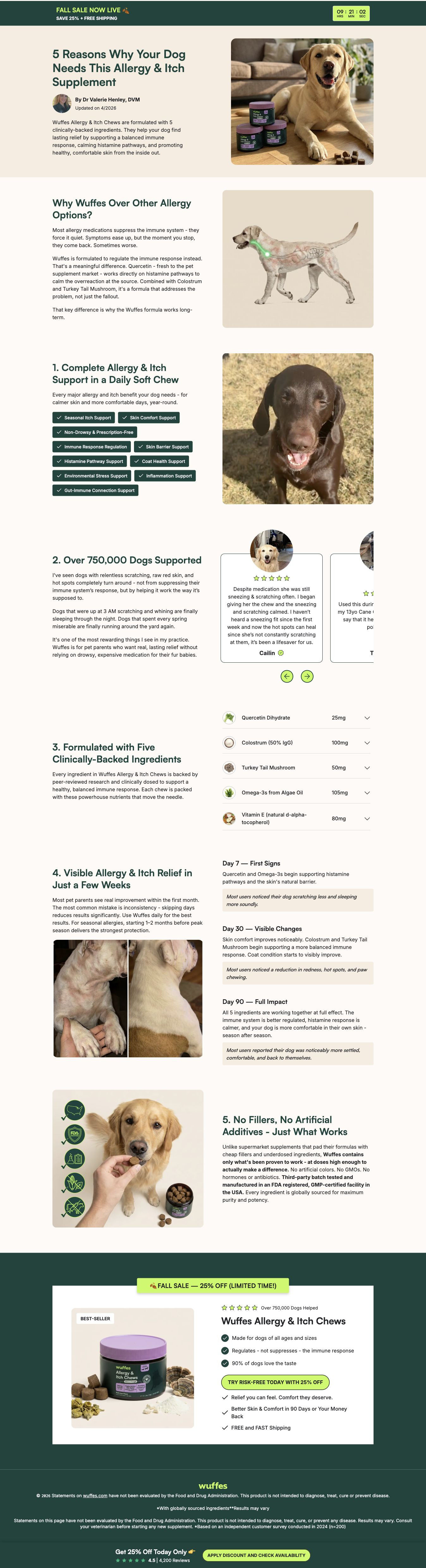
The ad links to the five-reason allergy listicle, an advertorial with an expert byline that fits a video already built as a lesson. Reason three continues the ingredient story with five ingredient rows, each with an icon, name and amount, so the viewer can check what the video named. The why-this-over-alternatives section and reason four's timeline (first week, first month, three months) add context the video skips. The offer card's risk-free CTA and guarantee lines pick up the 90-day trial from the ad.
The page it sends people to: How Wuffes' allergy advertorial tackles other remedies first
Wuffes' allergy page is a five-reason listicle advertorial with a veterinarian byline. A why-this-over-alternatives section comes before the reasons, which cover benefits, customer proof, ingredients, a timeline and quality, ending on one offer card and a sticky discount bar. Three ads in the Fluid library send people here, all problem-led videos about itching and licking.
How the page is built
- 01Sale bar
A sale headline with a discount-and-shipping line and a countdown timer answers is there a deal right now.
- 02Article hero
The listicle headline, an expert byline with headshot and updated date, an intro and a photo of the dog with jars answer who's writing and what's this about.
- 03Why this over alternatives
Copy contrasting usual remedies with the product's approach, beside a dog illustration, answers why would this work when other things didn't.
- 04Reason one
A grid of check-mark pill tags listing benefit areas answers what does it claim to address.
- 05Reason two
A customer-count heading, first-person expert copy and a carousel of verified review cards answer do other owners vouch for it.
- 06Reason three
Five ingredient rows with icons, names and amounts answer what's in it.
- 07Reason four
A before and after photo and three milestone blocks with “most users noticed” notes answer how long will it take.
- 08Reason five
Quality copy with bolded claims beside a photo of the dog being fed and certification icons answers is it made to a high standard.
- 09Offer card
A Best-Seller card with a rating, three bullets, a risk-free button naming the discount and guarantee and shipping lines answers what's the deal and the risk.
- 10Footer and sticky bar
Disclaimers and a sticky bar with the discount line, rating and apply-discount button keep the offer in reach.
The first fixes we would make
- The ads that land here show different discounts (50% off plus a free gift in the comment videos, SAVE57% in the link path), and the page's sale bar carries its own discount line. Make the ad, link and sale bar show the same figure, so nobody arrives expecting one deal and finds another.
- The before and after in reason four is a single photo. Add a short video or a carousel of a few dogs' paws or skin before and after, labeled with each owner's name, since every ad that lands here is about visible itching.
Read the full breakdown of this page
Three hooks you could test
- Lead with the uncomfortable problem. “Red, raw paws after every walk? Here's what to look for.”
- Turn the benefit into a picture people get in a second. “Five symptoms, circled in red. One chew on the bowl.”
- Call out the habit you're replacing. “Done with messy baths that only last a day?”
What to borrow for your brand
- Draw your explainer by hand on camera and circle each point as the voiceover names it, so a list becomes something to watch.
- Structure the video as a numbered list of symptoms your buyer recognizes, each paired with what's in your product.
- Close an education video with the trial terms and a time limit, so learning ends in a next step.
Transcript
Five dog allergy symptoms, and the ingredient to fix them, is your dog scratching themselves wrong? Try corseton. It naturally blocks the intense urge to scratch. Obsessive paw licking and gnawing, tricolostrum, a conster dog's overactive immune system, yeast to meet ears? Try turkey tail mushroom. It balances gut health to starve out the yeast, hot spots, and dry and flamed skin. Charnel nated 3s from algae oil. It reduces inflammation and deeply hydrates the skin. Gunk built up in your dog's eyes? Tri vitamin E. This antioxidant clears up thick discharge. Luckily, you can find this 5 in one solution in Woost's allergy and its shoes. Start your 90 day risk free trial now while it's on sale.
Text on screen
- 5 dog allergy symptoms and
- the ingredient to fix them
- Colostrum
- Turkey Tail
- Mushroom
- Omega 3's
- (Algae Oil)
- Vitamin E
- PENFLEX
- 610097
- IS YOUR DOG
- RAW?
- Quercetin
- IT NATURALLY
- rcetin
- URGE TO SCRATCH
- Turk
- OBSESSIVE
- TRY COLOSTRUM
- lostrum
- IMMUNE SYSTEM
- TRY TURKEY T
- TAIL
- IT BALANCES
- TO STARVE OUT
- AND DRY
- TRY OMEGA 3'S
- Mus
- FROM ALGAE OIL
- AND DEEPLY
- ENFLEX
- THE SKIN
- EYES?
- PENFLE
- Omeg
- (Algae
- Vitar
- THIS ANTIOXIDANT
- CLEARS UP THICK
- waffes
One of 8 Wuffes ads in the Fluid Inspiration Library, captured from the Meta Ad Library on Oct 19, 2026. We record that an ad ran publicly, not how it performed.