

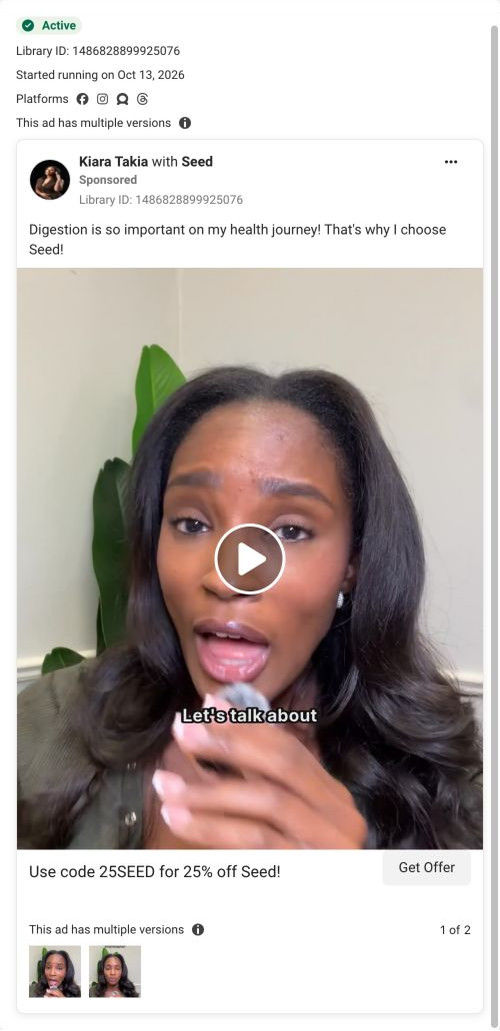
BobbyParrish with SeedSponsored
Esc
How Seed uses a "before you buy" hook from a creator
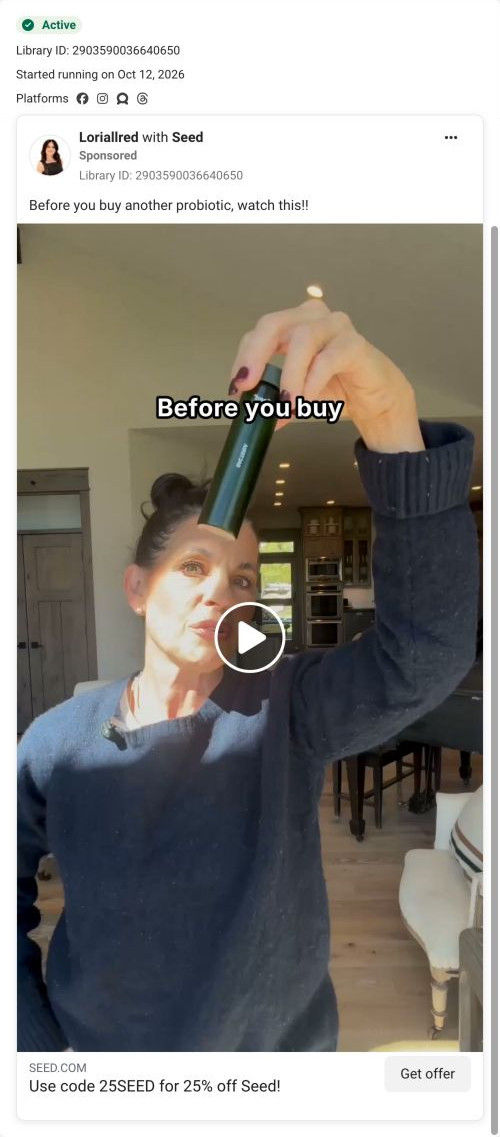
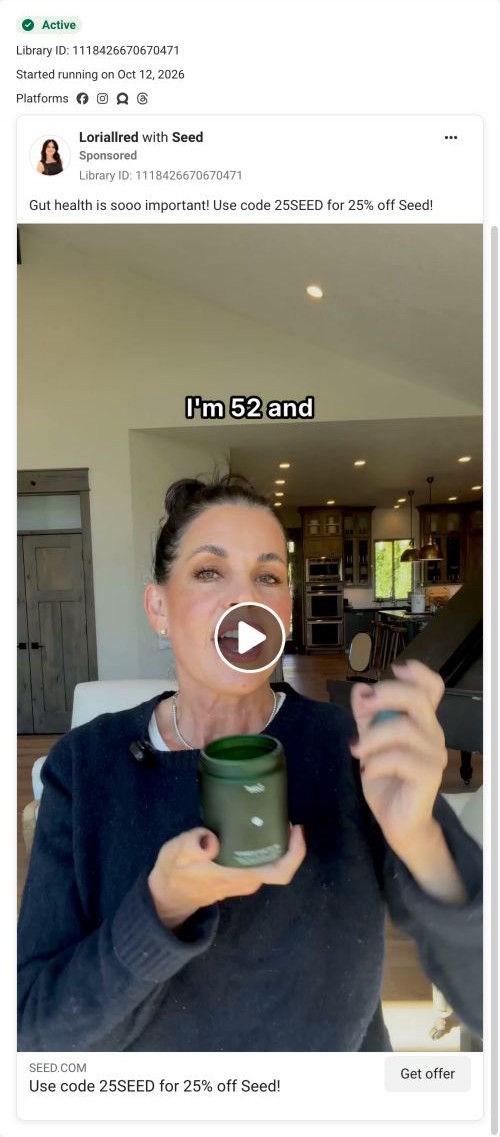
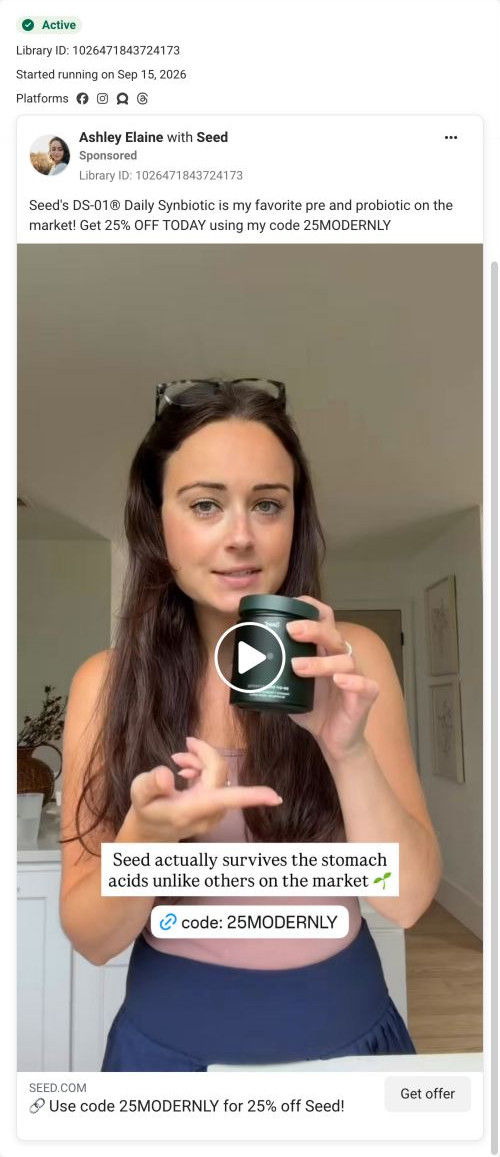
A creator video from Loriallred, filmed in her kitchen, holding a dark green Seed travel vial over her head under the caption "Before you buy." The copy reads as buying advice for anyone shopping for a probiotic. The headline offers 25% off with code 25SEED, and Get Offer opens Seed's DS-01 quiz.
Seed
43 creatives lead here1 / 43





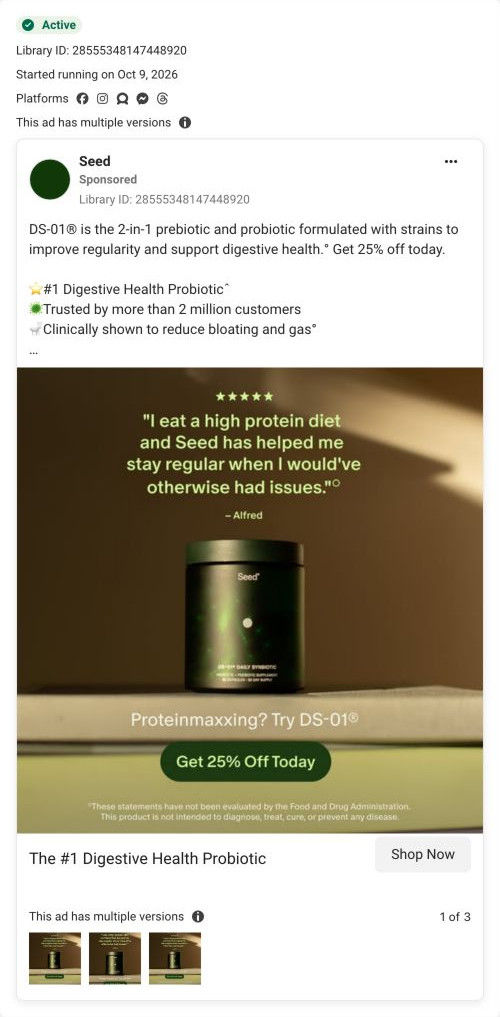


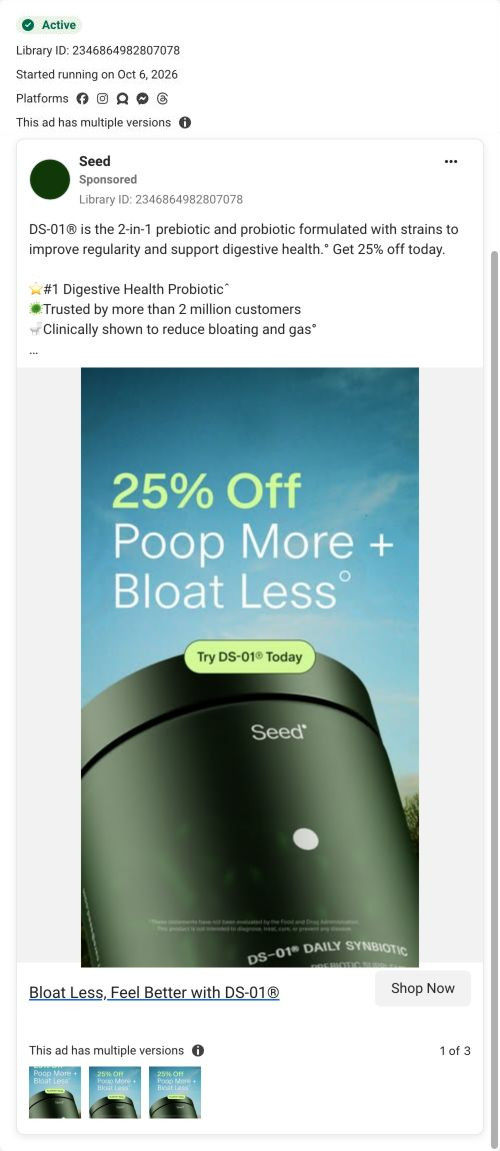
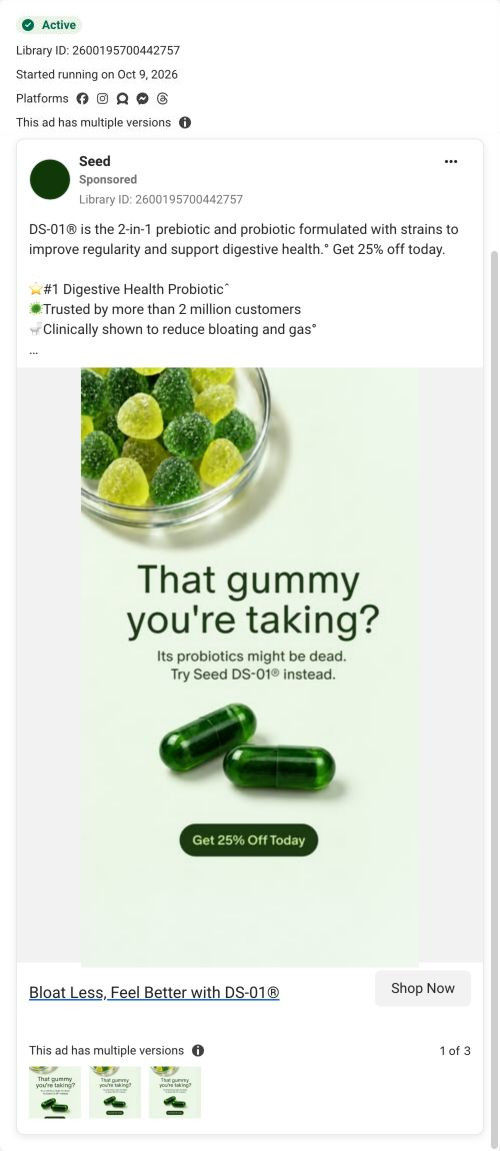

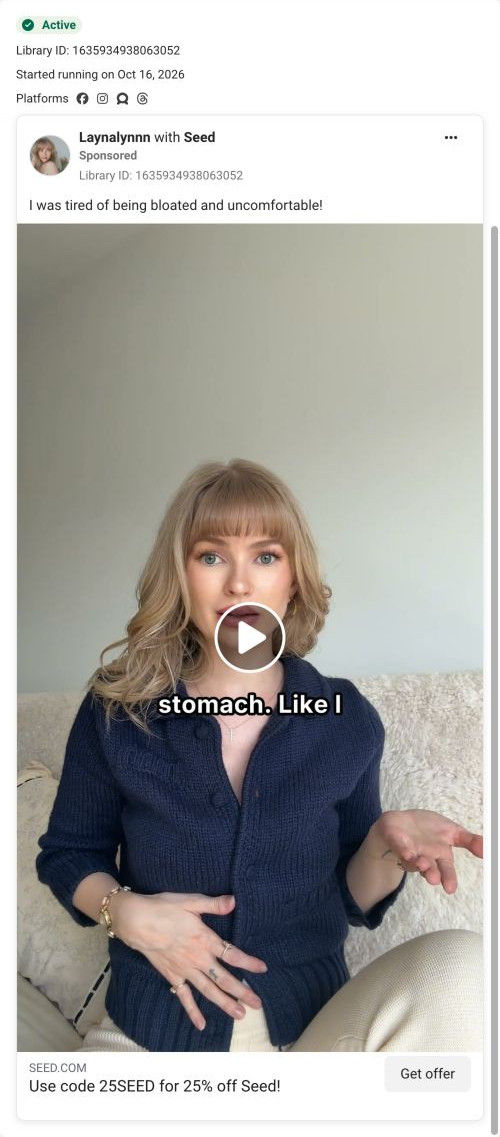
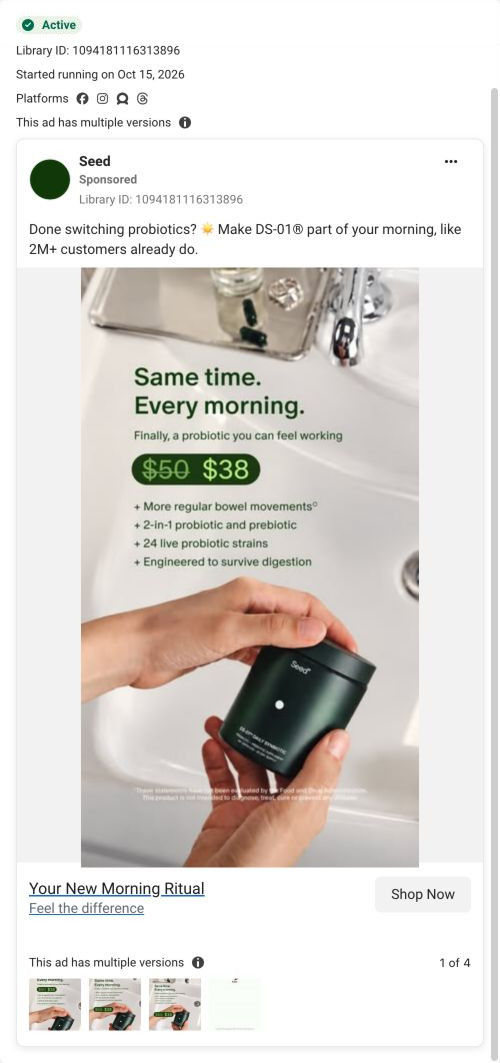
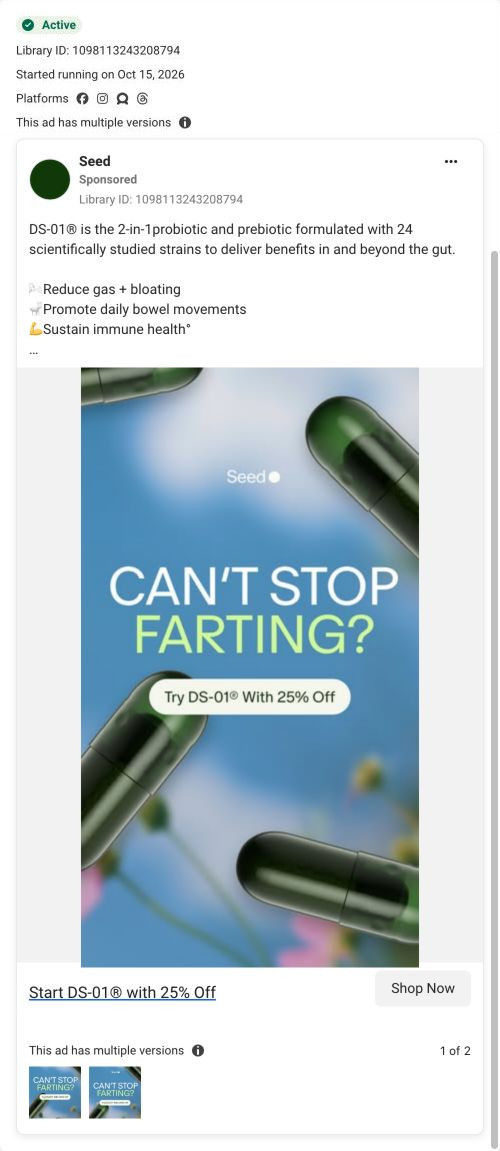


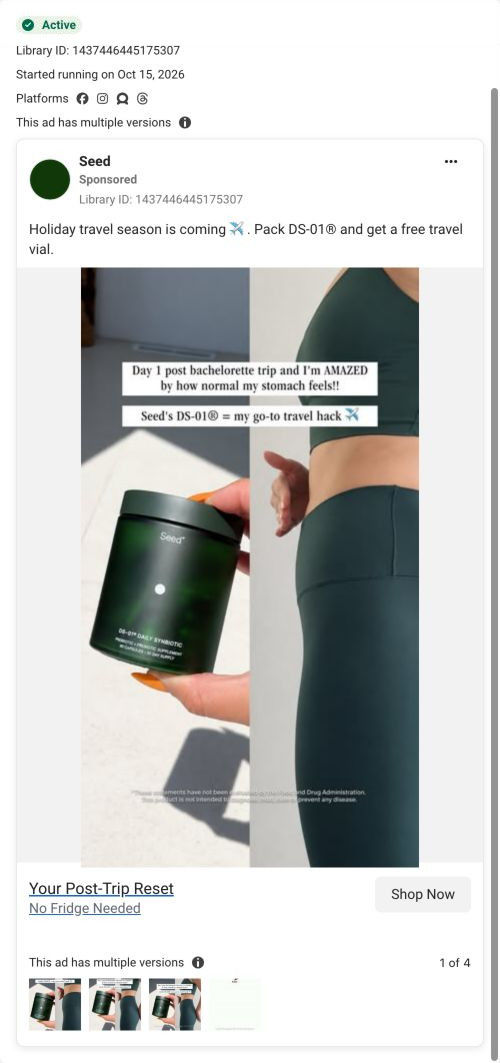
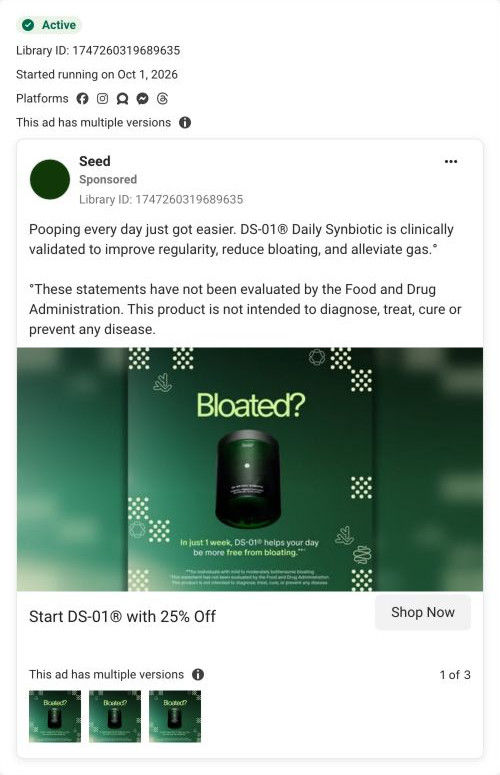
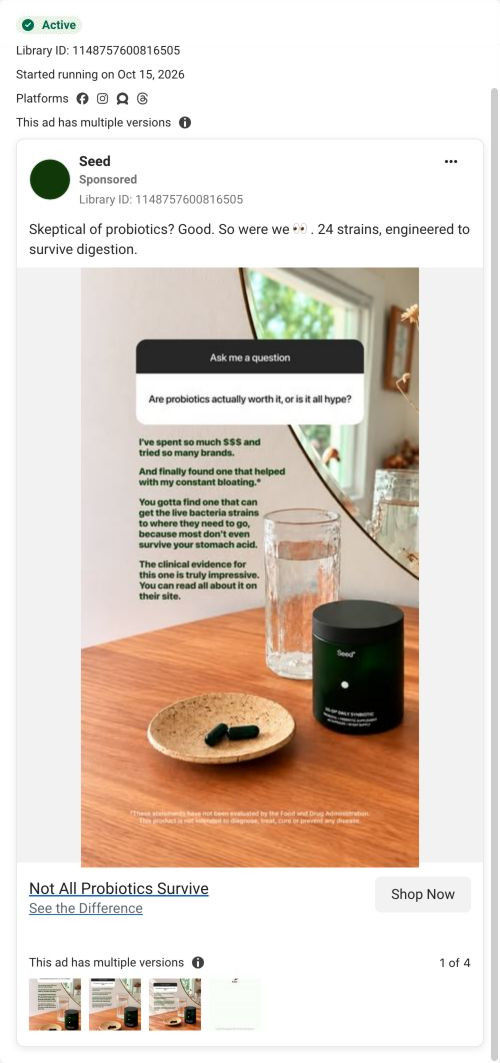
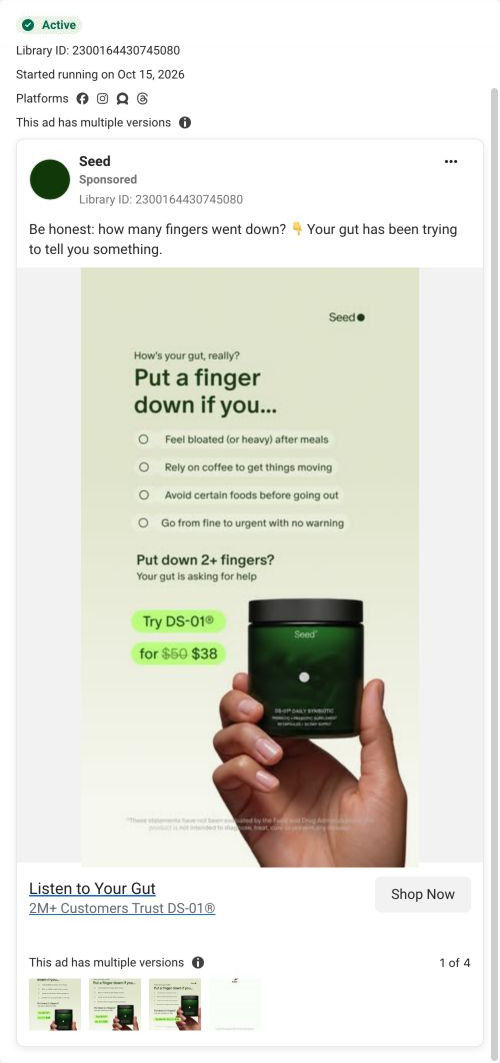
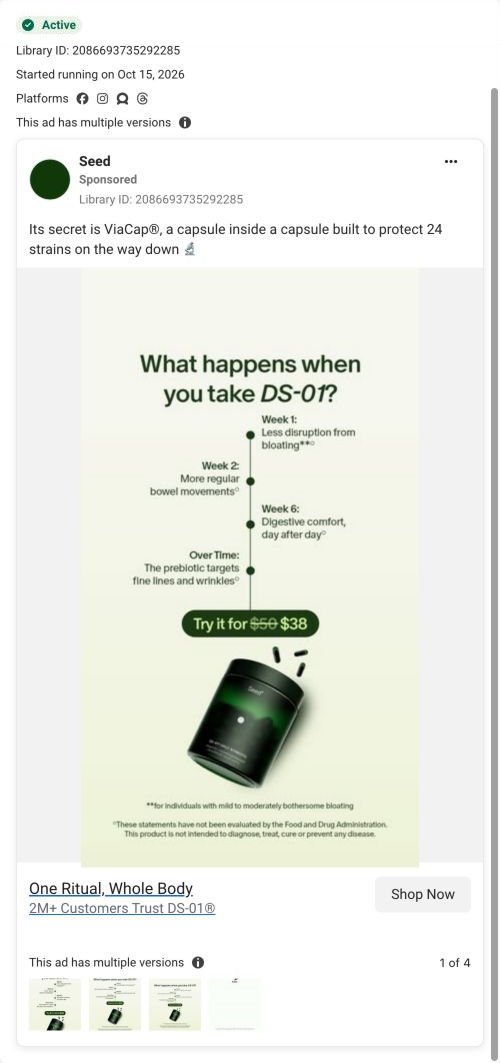
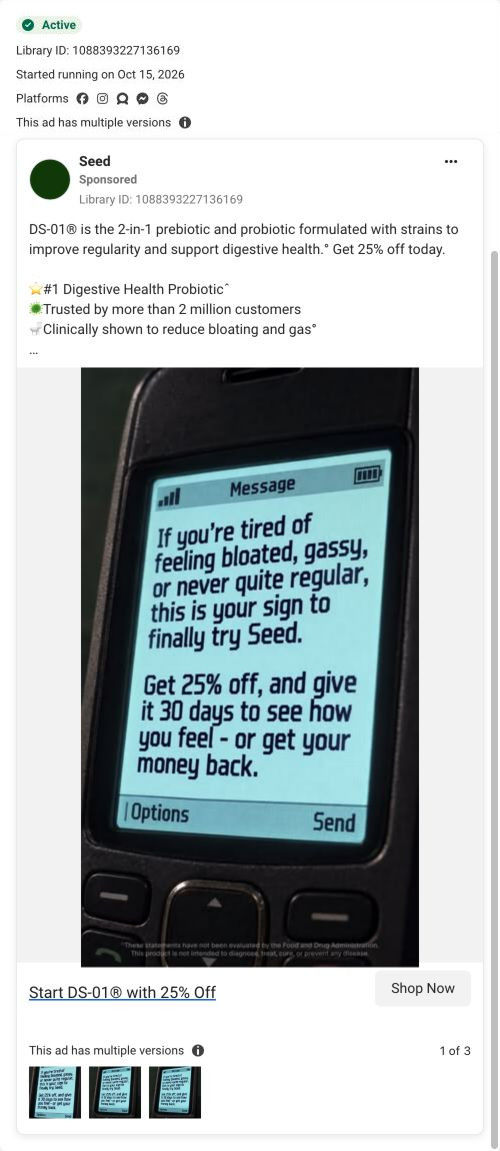
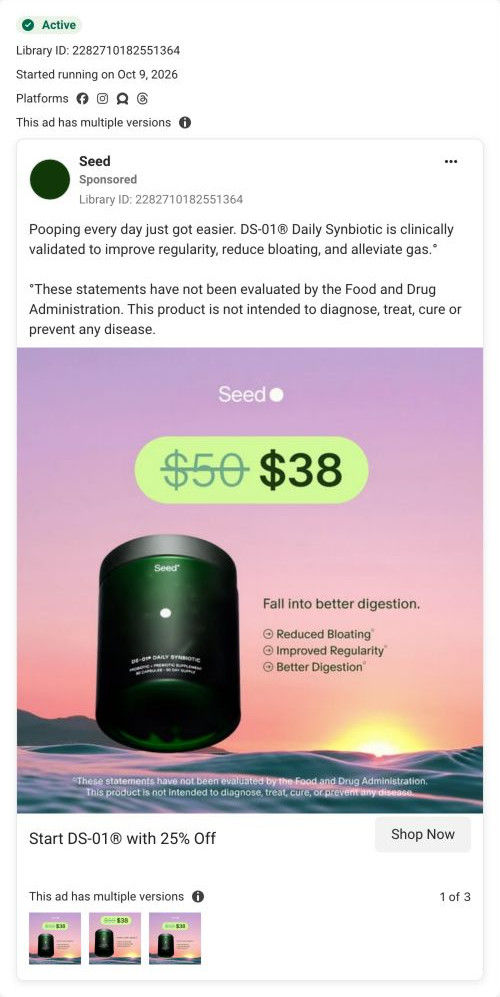
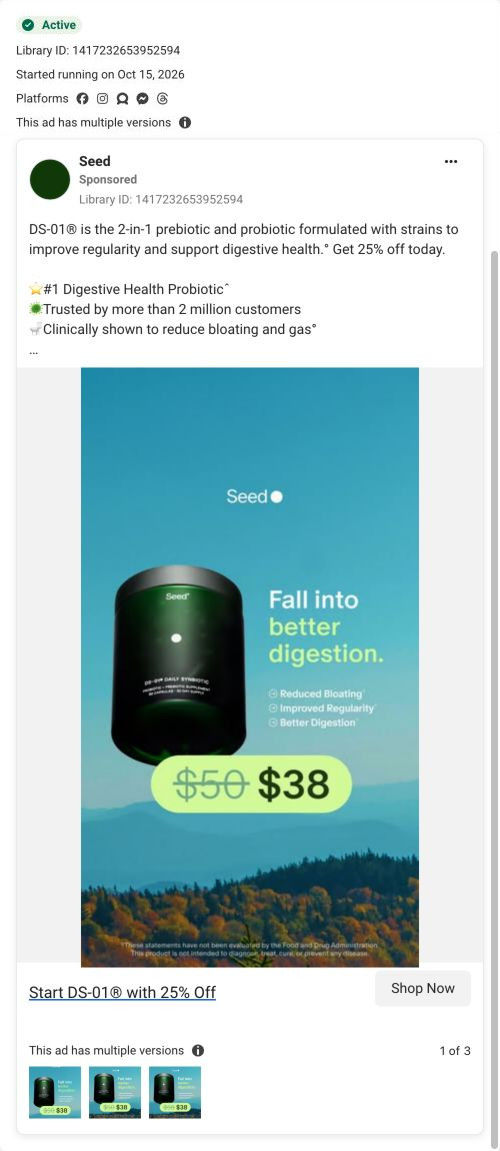
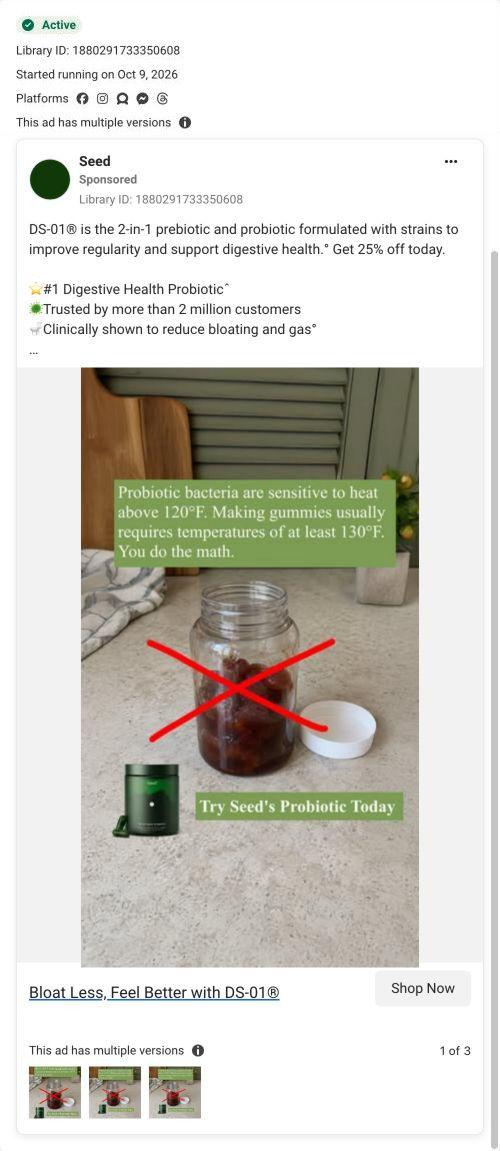
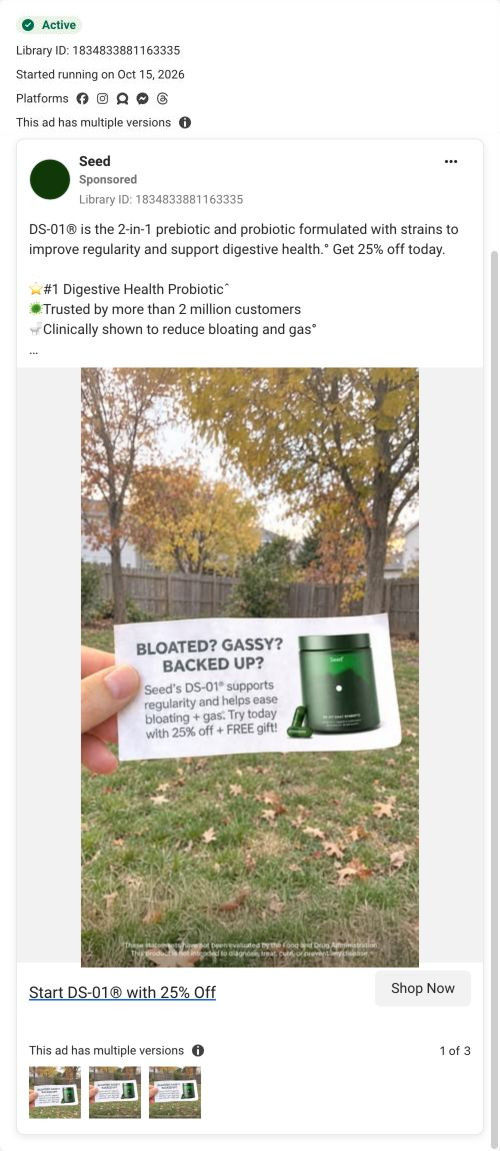
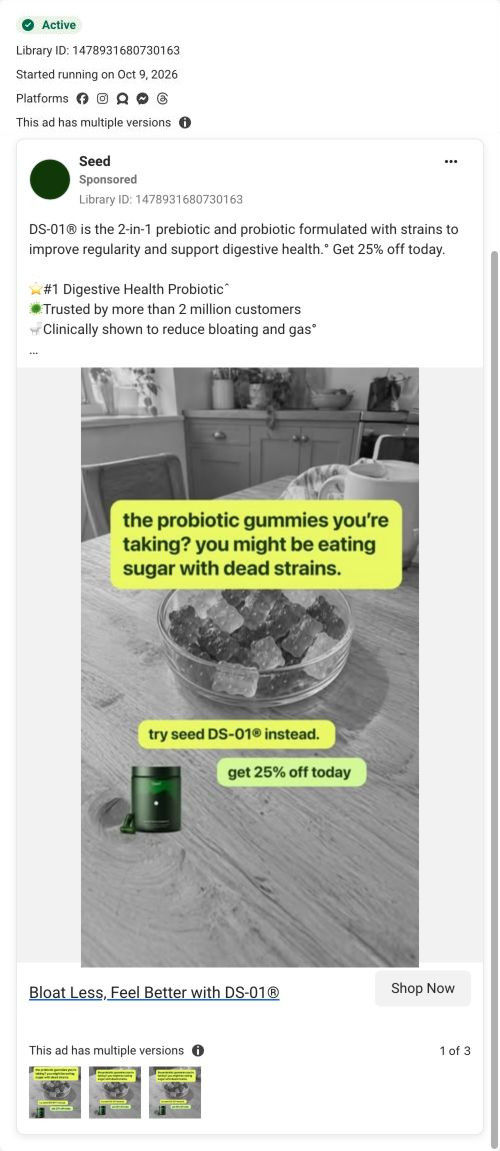
The Seed DS-01 quiz entry
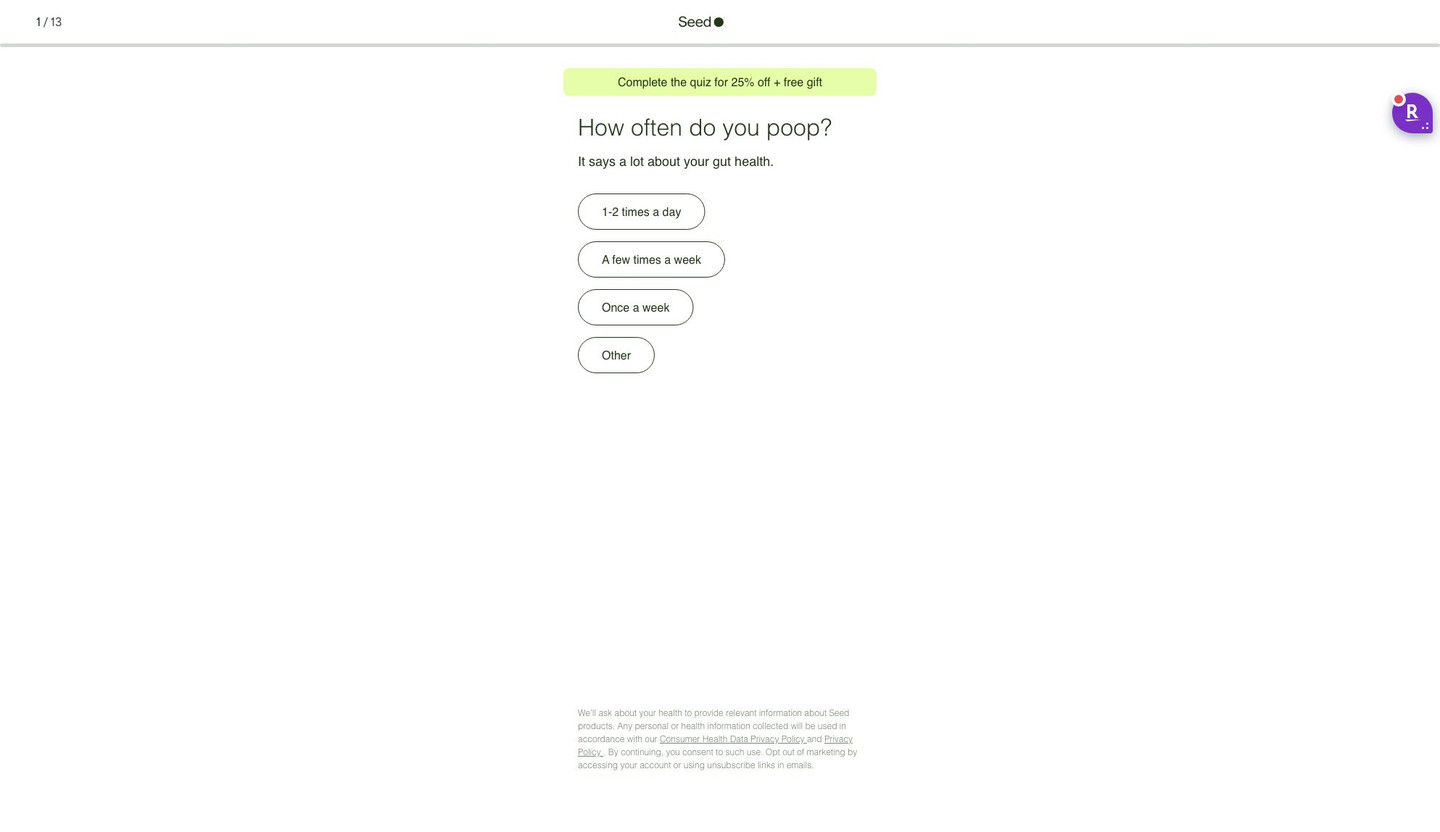
Quiz entry screen only; personal health questions were not answered. A browser shopping-extension badge appears in the upper-right margin of this capture.
Before you buy another probiotic, watch this!
A creator-led buying-advice hook asks people to pause before their next probiotic purchase. The code-bearing CTA now opens a 13-step quiz starting with “How often do you poop?” and promoting 25% off plus a free gift for completion. Compare the creative with the destination and explore the other ads sharing this route.
- Brand
- Seed
- Observed offer
- Advertised 25% off with code 25SEED
- Creative angle
- Creator-led
- Page type
- Quiz
- Ad format
- Video
- Listed start date
- Oct 12, 2026
- Captured
- Oct 19, 2026
- Library ID
- 2903590036640650
- Destination
- seed.com
Selected for its design and offer structure. Ad performance isn’t available in this collection.
What this ad does well
The hook speaks to someone mid-decision. Telling people to stop before their next probiotic purchase assumes the viewer is already shopping or already taking one, which is exactly the person most likely to act on a discount. Holding the vial up high in a lived-in kitchen makes it feel like a real recommendation rather than a brand spot. The headline puts a clear number on the offer (25% off) next to a code, so the reason to act is spelled out before anyone taps.
What's missing
From the captured copy and opening frame, the ad leans entirely on curiosity: it never says what the viewer should check before buying or what problem this probiotic is meant to solve. There's no transcript in our capture, so we can't judge what she says in the middle, but the parts we can see give no proof or outcome. If you make one like this, put the one thing to check in the caption itself ("Before you buy, check whether it survives your stomach") so the hook teaches something even for people who scroll past.
Beat by beat
- Opening frameThe creator holds a dark green Seed travel vial above her head in her kitchen, under the caption "Before you buy."
It catches people who are about to purchase and makes the product the focus of the frame.
- Copy"Before you buy another probiotic, watch this!!"
It speaks to people already in the category and promises useful advice.
- CTAUse code 25SEED for 25% off Seed, with a Get Offer button.
It gives a specific reason to tap and frames the discount as a code worth using.
The offer
25% off with code 25SEED, stated in the ad's headline next to the Get Offer button.
Where it sends people
Get Offer opens Seed's DS-01 quiz with code 25SEED, and a quiz is often the strongest landing option because it asks what the visitor is dealing with before recommending anything. The entry screen's banner promises a discount and a free gift for finishing, which carries the 25% forward and adds a gift. Because the quiz screen shows only the offer and one question, it fits a buying-advice hook like this one, which never commits to a specific benefit. Someone expecting the "before you buy" tip won't find it on the page, so the ad should deliver it before the click.
The page it sends people to: How Seed's DS-01 quiz turns every ad into the same first question
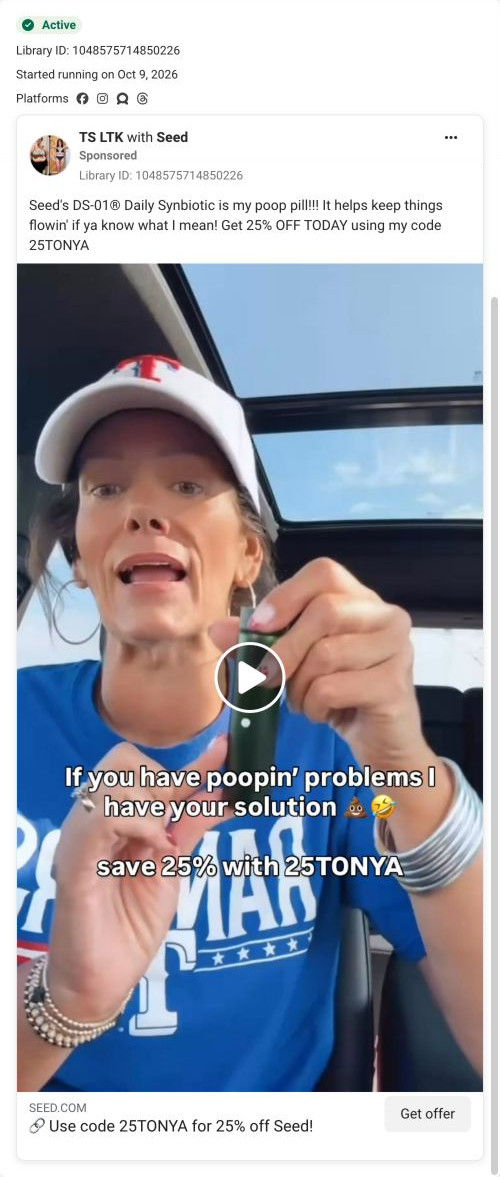
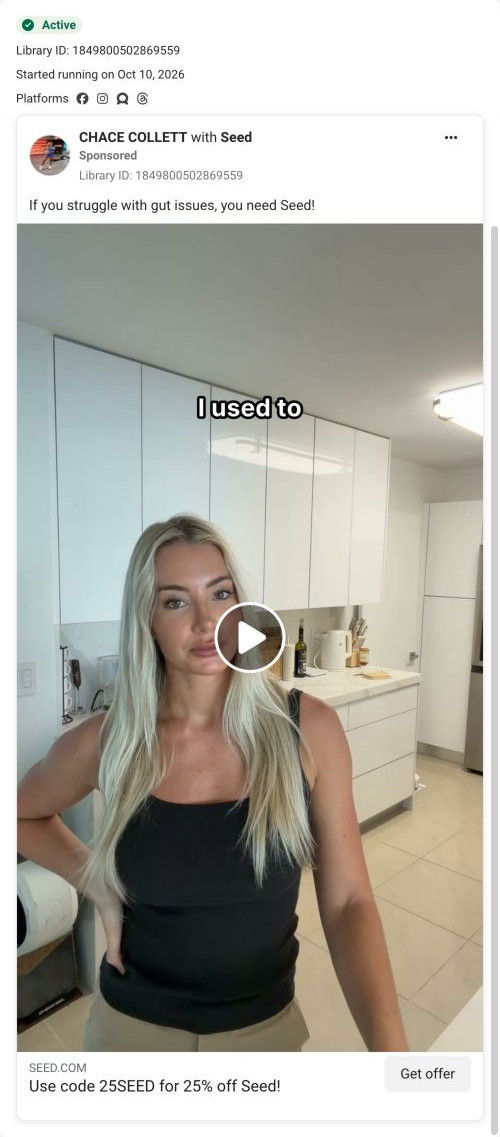
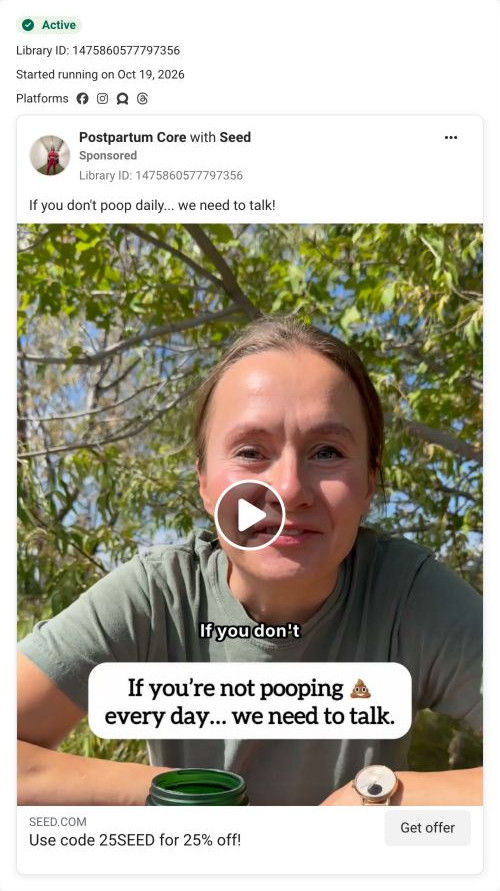
Seed's DS-01 quiz entry is a 13-step quiz captured on its first screen: a step counter, a banner offering 25% off plus a free gift for finishing, one tap-only question and a consent note. Forty-three ads in the Fluid library send people here, from creator promo-code videos to problem-led, bloating and discount ads.
How the page is built
- 01Header
A 1 / 13 step counter, the centered logo and a thin progress bar answer how long this is going to take.
- 02Offer banner
A highlighted pill promises 25% off plus a free gift for completing the quiz, which answers what the visitor gets for finishing.
- 03Question
A large question about a daily habit, with a one-line reason it matters, answers why Seed is asking.
- 04Answers
Four stacked pill buttons with frequency options let the visitor answer in one tap, with no Next button to find.
- 05Consent note
Small privacy and data-use text at the bottom answers what happens to the health information they share.
The first fixes we would make
- Creator traffic arrives with a code in the URL (25BOBBY, for example), but the banner reads the same for everyone and never mentions the creator. Add a line like "Bobby's 25% off is applied" for coded traffic, so a viewer who just watched that creator knows they're in the right place.
- The screen doesn't say what the visitor gets at the end besides the discount. Add one short line under the banner saying the quiz ends with a recommendation on whether DS-01 fits them (the page address already asks that question), so 13 steps feel worth finishing.
Read the full breakdown of this page
Three hooks you could test
- Call out the habit you're replacing. “Before you reorder your usual [category], watch this.”
- Lead with the uncomfortable problem. “If you've tried three [category] and none of them did anything, here's why.”
- Make the product the whole scene. “This is the only [category] I keep in my bag.”
What to borrow for your brand
- Open with a "before you buy" line aimed at people already shopping your category, since they're closest to a decision.
- Have the creator hold the product high and centered in a real room so it reads as a personal recommendation.
- Put the discount number and the code together in the headline so the reason to act is visible without watching.
One of 50 Seed ads in the Fluid Inspiration Library, captured from the Meta Ad Library on Oct 19, 2026. We record that an ad ran publicly, not how it performed.