
RoSponsored
Esc
How Ro's Trisha Paytas ad speaks to people without insurance
A 17-second Ro video with Trisha Paytas, a paid partner and Ro member, standing outdoors in pink and holding a phone that shows the Ro app greeting her by name. The angle is cost for people without insurance coverage. There's no discount, and the click goes to a Trisha-themed weight-loss quiz.
Ro
9 creatives lead here1 / 9
Ro · Trisha weight-loss quiz
Public page captured October 22, 2026. Promotional sheets and temporary interface overlays were dismissed or removed in the static reference. No personal or medical information was entered. Captured entry screens do not reproduce the complete consultation.
See if you qualify
Visual reference: Trisha · phone and poolside story. Pink testimonial, crystal-ball and product-table creatives lead to a Trisha-specific hero. The question-card structure matches the other weight-loss entrances; the captured next state follows the Learn about both option. Compare the creative with the destination and explore the other ads sharing this route.
- Brand
- Ro
- Observed offer
- Online GLP-1 assessment; medication and membership terms apply
- Creative angle
- Creator stories
- Page type
- Quiz entry
- Ad format
- Video · 0:17
- Listed start date
- Sep 4, 2026
- Captured
- Oct 22, 2026
- Library ID
- 1405616458168908
- Destination
- ro.co
Selected for its design and offer structure. Ad performance isn’t available in this collection.
What this ad does well
The first caption, "Don't have insurance coverage?", picks out a specific viewer and gives them a reason to stay. Trisha holds the phone up to the lens with a Hello, Trisha! screen and a weight-progress card, which shows the product (an app you use from your phone) instead of only talking about it. At 17 seconds it's short, and every line moves forward: the objection, Ro's cash-price claim, her own decision, and the call to see if you qualify. The pink set and outfit are unmistakably hers, so fans recognize her before the first word.
What's missing
The ad claims Ro has the lowest price on FDA-approved GLP-1s for cash-pay customers, and that's the whole argument, yet no price appears. Someone without insurance is exactly the person who wants the number, so leaving it out means they have to click just to find out if this is realistic. If you make one like this, show the starting price on screen when the claim is made, and add a short line on what happens after the click (questions, provider review) so the next step feels small.
Beat by beat
- 0-3sTrisha holds up a phone showing the Ro app greeting her, under a caption asking if you don't have insurance coverage.
It calls out the uninsured viewer and shows the product in the same frame.
- 3-8sShe says Ro has the lowest price on FDA-approved GLP-1s when you pay cash.
This is the core claim, aimed straight at the objection raised in the hook.
- 8-13sShe says if she's starting GLP-1s, she's doing it on Ro, and talks about feeling more confident and energetic.
Her personal choice works as an endorsement, and the feelings give the outcome a picture.
- 13-17sThe CTA tells viewers to go to ro.co to see if GLP-1s are right for them, with safety text on screen.
The ask is to check eligibility, which is a smaller step than buying.
The offer
No discount. The creator says Ro has the lowest price on FDA-approved GLP-1s for cash pay, and the screen notes an additional Ro membership fee.
Where it sends people
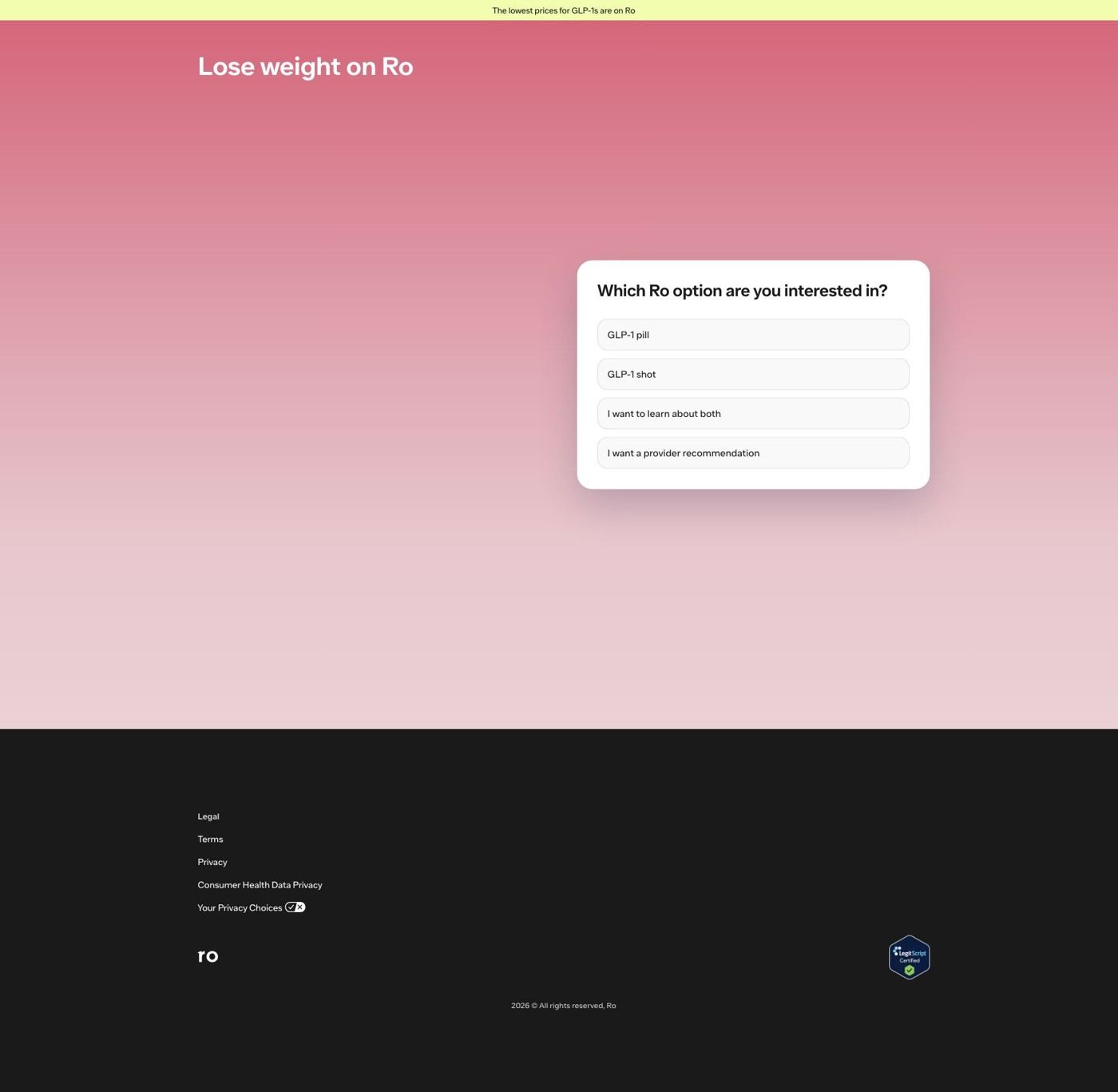
The ad sends people to Ro's Trisha weight-loss quiz, one of 9 ads in the Fluid library that land there. That's a quiz entry, usually the strongest place to send ad traffic: the page opens with the headline Lose weight on Ro and a single question card asking whether you're interested in a GLP-1 pill, a GLP-1 shot, both, or a provider recommendation. The pink gradient carries Trisha's palette across the click, and a yellow banner repeats the lowest-price line. What it doesn't pick up is the ad's specific promise about paying without insurance. If you build a page like this, add a cash-pay answer or price-from line under the question, so the person who clicked because they're uninsured sees their question answered first.
The page it sends people to: How Ro built a pink quiz page for its Trisha Paytas weight-loss ads
Ro's Trisha Paytas landing page is a quiz entry on a pink gradient, with Trisha holding a pen-style product beside the GLP-1 format question. It's the destination for 9 Ro video ads in the Fluid library, almost all creator-story videos (pink testimonial, crystal-ball and product-table creatives), each ending on See if you qualify.
How the page is built
- 01Announcement bar
The yellow strip claims the lowest prices for GLP-1s are on Ro, the page's only answer to 'what will this cost?'
- 02Headline
Lose weight on Ro, set in white on the pink gradient, confirms the category and brand right away.
- 03Treatment-format question
The card asks which Ro option you're interested in, so visitors arriving from the product-table ad can pick the format they saw.
- 04Trisha Paytas photo
Trisha holds a pen with sparkles around her and a Ro member label, answering 'is this the person from the video?' in the ads' own playful style.
- 05Weight-goal question
After Learn about both, the card asks how much weight you're looking to lose in ranges plus Not sure yet, continuing the quiz in place.
- 06Footer
Legal and privacy links and a LegitScript Certified badge give scrolling visitors a legitimacy check.
The first fixes we would make
- One of the ads here is a product-table creative, and the page drops the table entirely. Bring a compact version of that comparison into the format question (one line per option, in the ad's words), so the viewer who clicked to compare can do it right where they choose.
- The headline is the same Lose weight on Ro used on every weight-loss entrance, so the copy doesn't carry Trisha's voice the way the colors and photo do. Use a headline that echoes the line her testimonial videos open on, so the words match the look.
Read the full breakdown of this page
Three hooks you could test
- Lead with the uncomfortable problem. “No insurance? Here's how people are paying for [product] anyway.”
- Make the product the whole scene. “Hold your phone to the camera and show the app screen that greets your customer by name.”
- Sell the outcome. “Feel more like yourself again, and know what it costs before you start.”
What to borrow for your brand
- Have the creator hold the product interface up to the lens in the opening frame, so viewers see what they'd use while the hook plays.
- Write the hook as a yes-or-no question about the buyer's situation, so the right viewer self-selects in one line.
- Keep a single-claim ad under 20 seconds, with each line answering the one before it.
Transcript
Don't have insurance coverage, no stress. Roe has the lowest price, FDA approved GLP ones when you're paying cash. If I'm starting GLP ones for weight loss, I'm doing it on row. Duh, why wait to feel healthier? More competent, more energetic, seriously, go on road.co to see if GLP ones are right for you.
Text on screen
- PROTECTED
- PROT
- OTECTE?
- Hello,
- Trishat
- Weight
- Paid partner and Ro member
- Additional Ro membership fee required.
- Don't have insurance coverage?
- OTE
- Hello.
- Trisha!
- Additional Ro membership fee requireu.
- No stress, Ro has the lowest price
- ECTED
- FDA-approved GLP-1s
- OTECTED
- Additional Ro membership fee required:
- when you're paying cash.
- ATED
- VECTED
- If I'm starting GLP-1s
- PRON
- I'm doing ition Ro....
- CTED
- OTECTE
- Why wait to feel healthier,
- -TED
- more confident, more energetic?
- PROTEC
- BROA
- PRO
- Exonly See side effects of GLP- (medicatons,
- Including Boxed Warning, at o.co/safety
- See if you qualify
- go on ro co to see if
- BROT
- including Boxed Warning, at ro coysafety
- GLP-1s are right for you.
- OTEC
One of 100 Ro ads in the Fluid Inspiration Library, captured from the Meta Ad Library on Oct 22, 2026. We record that an ad ran publicly, not how it performed.