

RitualSponsored
Esc
How Ritual sells a midlife supplement stack as a romanticized routine
A 16-second Ritual video styled as an aesthetic tray (a candle, flowers, glassware and a basket of supplement jars) under the caption “Romanticizing my supplement routine at 40.” Numbered overlays introduce Perimenopause Health and Stress Relief with the ad's claims for each, then offer up to 30% off for stacking them. It links to the Perimenopause Support collection page.
Ritual
1 creative lead here1 / 1
Ritual · Perimenopause Support collection
Captured while scrolling the public page. The page reflects the offer visible on October 20, 2026; it may differ from the original ad.
30% Off Midlife Support*
A styled tray, glassware and flowers frame a daily supplement routine for women over 40; the copy advertises a Perimenopause Health and Stress Relief pairing. Compare the creative with the destination and explore the other ads sharing this route.
- Brand
- Ritual
- Observed offer
- Up to 30% off midlife support
- Creative angle
- Use occasion
- Page type
- Collection page
- Ad format
- Video · 0:16
- Listed start date
- Oct 16, 2026
- Captured
- Oct 20, 2026
- Library ID
- 1709906624477811
- Destination
- ritual.com
Selected for its design and offer structure. Ad performance isn’t available in this collection.
What this ad does well
Ritual borrows a format people already watch on purpose: the romanticize-your-routine video, with a styled tray, a candlestick and fresh flowers instead of a product on white. That makes a midlife supplement feel like a small pleasure rather than a chore. The overlays then number the products (#1 Perimenopause Health, #2 Stress Relief), so in a few seconds the viewer learns there's a pair and what the ad says each one is for. The copy ties the discount to the pairing, which nudges toward a two-product order instead of a single bottle.
What's missing
The pretty tray carries the mood, but the reason to care stays in small text. The overlays list the brand's claims (the ad says Perimenopause Health supports hormone balance, hot flashes, night sweats and mood, and that Stress Relief supports cortisol levels), yet no person or moment connects them to the viewer's own week. If you make one like this, keep the aesthetic and add one real moment in the opening frames, ideally in a customer's own words, so the viewer recognizes herself before she sees the jars. The stack offer would also land harder if the page it opens had the pair ready to buy together.
Beat by beat
- 0-3sA styled tray with a candle, flowers, a coupe glass and a basket of supplement jars appears under the caption about romanticizing a routine at 40.
It signals a familiar lifestyle format and names the age group in the first line, so the right viewer knows it's for her.
- 3-8sAn overlay introduces #1: Perimenopause Health with three claimed benefits and shatavari extract.
Numbering the product sets up a short list the viewer can follow to the end.
- 8-13sA second overlay introduces #2: Stress Relief with the ad's cortisol and ashwagandha claims.
It turns one product into a pair, which is what the offer is built on.
- 13-16sThe final caption offers up to 30% off when you stack the two.
It ends on the reason to buy both now, though without a deadline.
The offer
Up to 30% off when you pair Perimenopause Health with Stress Relief, stated in the copy, the headline and the final caption. Framing the discount around a stack, rather than one bottle, gives the viewer a reason to start with two products.
Where it sends people
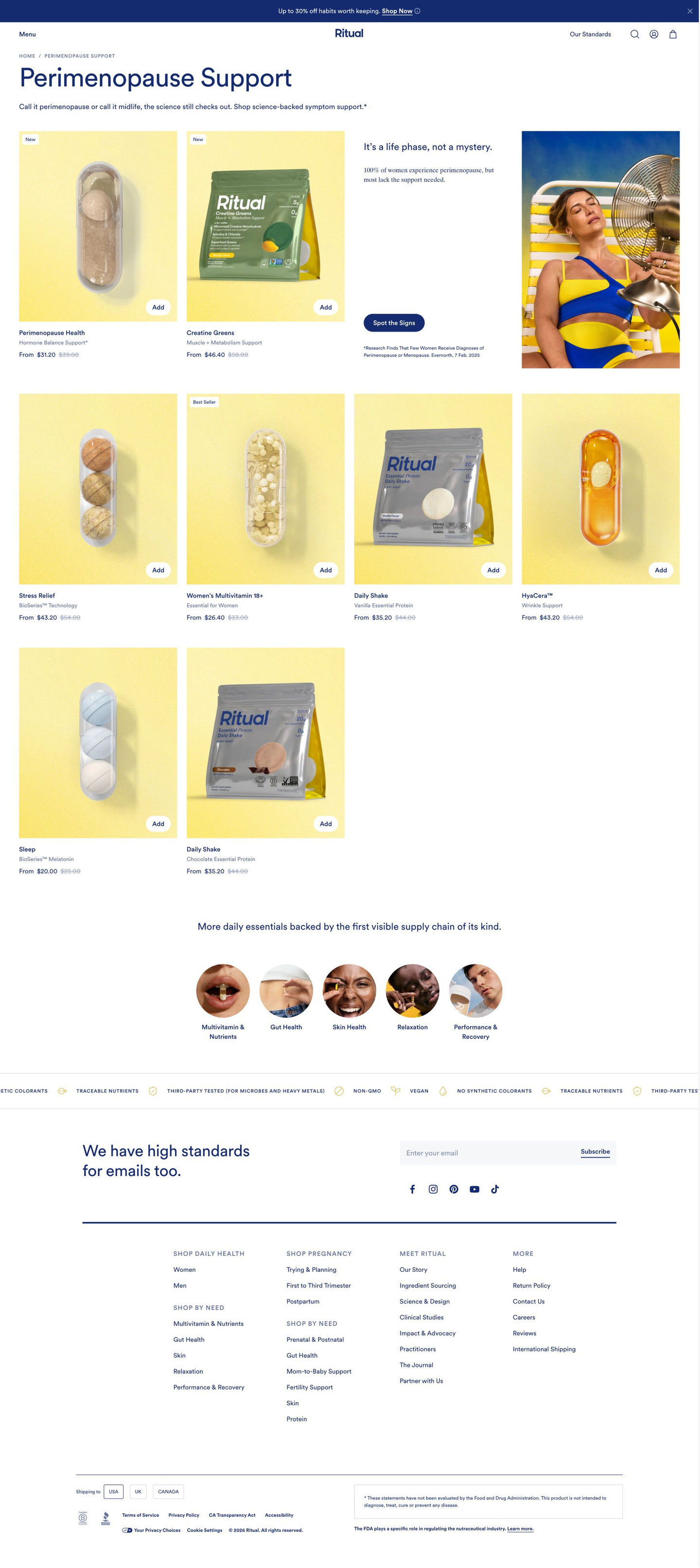
The ad sends people to the Perimenopause Support collection page, which sits between a product page and a focused landing page. It opens with the collection title and a product grid, and the grid's first row includes an editorial tile with a “Spot the signs” button that links to a symptom guide, which suits a viewer who is still putting a name to what she's feeling. Quick Add buttons let her buy straight from the grid. The gap is the offer: the ad sells a specific two-product stack, but the blueprint shows no ready-made pair on the page, only individual cards and a site-wide percent-off line, so the visitor has to rebuild the stack herself. Landing on a pre-built pair, the way Ritual's starter-set pages work, would match the ad exactly.
The page it sends people to: How Ritual builds a collection page around one life stage
Ritual's Perimenopause Support collection page gathers products for one life stage in a grid, with an editorial tile in the first row that links to a symptom guide, then sends visitors on to other need categories. 1 ad in the library sends people here: a romanticized supplement-routine video offering up to 30% off a Perimenopause Health and Stress Relief stack.
How the page is built
- 01Announcement bar and header
A percent-off line with a Shop Now link sits above a centered-logo header with a standards link, answering whether there's a sale on.
- 02Collection header
A breadcrumb, a large collection title and a one-line intro answer what this collection is for.
- 03Grid, first row
Two product cards with New tags sit beside an editorial tile with a headline, an awareness stat, a Spot the signs button, a citation and a lifestyle photo, answering whether this life stage applies to the visitor.
- 04Grid, remaining rows
Four-column product cards on tinted backgrounds, with New or Best Seller tags, quick Add buttons and struck-through from prices, answer what's available and what it costs.
- 05Category links
A headline about other daily essentials and five circular photo links send visitors to other need categories.
- 06Standards marquee
A scrolling strip of icon-and-label claims answers how the products are made.
- 07Newsletter and footer
An email signup, social links, link columns, a country selector and the supplement disclaimer close the page.
The first fixes we would make
- The ad sells a specific two-product stack, but the page shows only individual cards, so the visitor has to find both products and add them one by one. Put a pre-built pair card (Perimenopause Health plus Stress Relief, with the stack saving shown) at the top of the grid, or send the ad to a starter-set page like Ritual's other bundles.
- The cards show names, subtitles, prices and tags but no ratings or review counts, so there's no proof on the page at all. Add a star rating and review count to each card, so a visitor comparing products has a signal beyond the badge.
Read the full breakdown of this page
Three hooks you could test
- Turn the benefit into a picture people get in a second. “My whole midlife routine fits on one tray.”
- Show a specific moment of use. “What's on my nightstand at 40.”
- Call out the habit you're replacing. “I stopped treating my supplements like homework.”
What to borrow for your brand
- Shoot your product inside a styled scene people already save and share, such as a tray, a vanity or a bedside table, so it feels like a lifestyle post first.
- Number the products on screen (#1, #2) when you're selling a pair, so the viewer follows a short list and remembers both names.
- Tie the discount to buying the pair together, and send the click to a page where the pair is already one item in the cart.
Transcript
How can I? Tell me, tell me, tell me. How can I get through? Did you know me?
Text on screen
- Romanticizing my supplement
- routine at 40.
- #1: Perimenopause Health*
- Support daily hormone balance
- Support daily hormone balance*
- Ease hot flashes and night sweat
- Support mood"
- with Shatavani Extract
- Ease hot flashes and night sweats*
- Support mood*
- with Shatavari Extract
- #2: Stress Relief
- Help reduce stress
- Stress Relief
- #2: Stress Relief*
- Support natural cortisol levels
- with clinically studied Shoden®
- Ashwagandha.*
- Get up to 30% off when you stack
- relief.
- Getup to 30% off when you stack
- relief
One of 20 Ritual ads in the Fluid Inspiration Library, captured from the Meta Ad Library on Oct 20, 2026. We record that an ad ran publicly, not how it performed.