

ProseSponsored
Esc
How Prose speaks to changing gray hair with a switching story
A 66-second voiceover video for Prose that opens on shampoo poured over a mirror with a caption about quitting generic shampoo for gray hair. The narrator describes texture and shine changing with age, then the reviews, the quiz and custom products. The copy offers 60% off with a subscription, and the link lands on a sign-in gate.
Prose
17 creatives lead here1 / 17
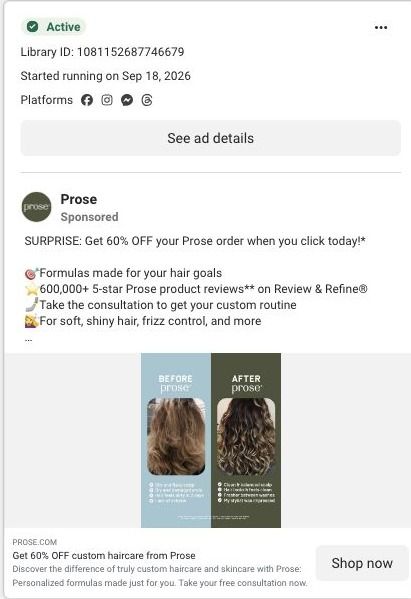
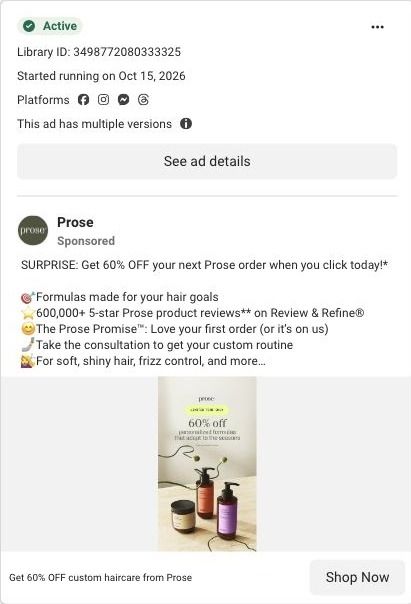

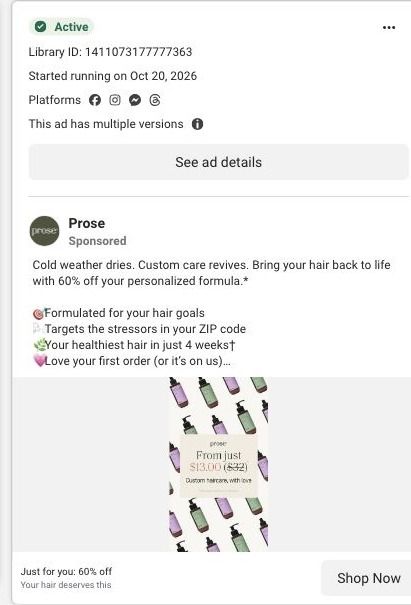


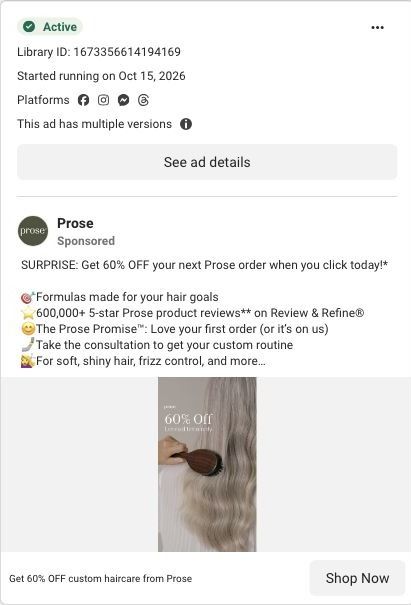
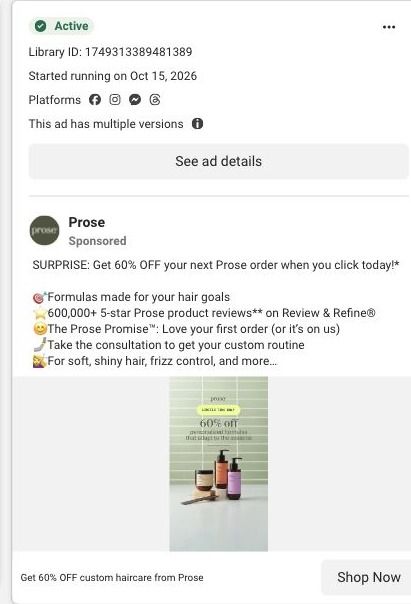

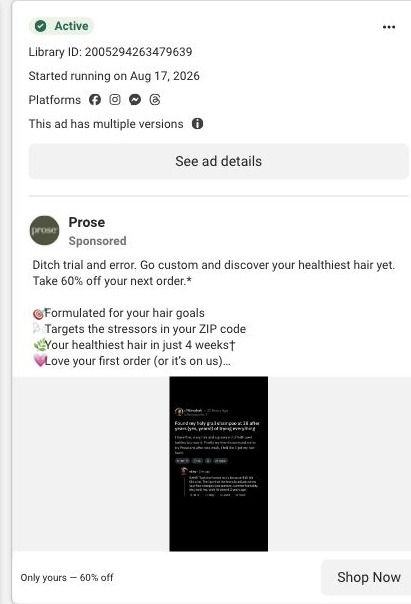
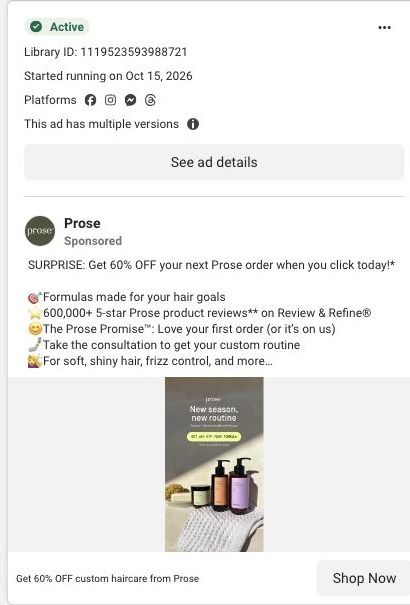
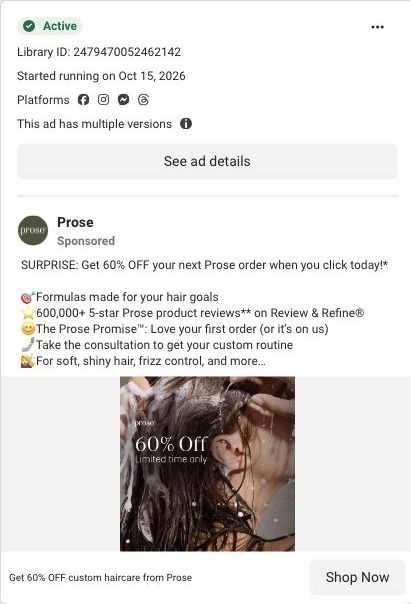
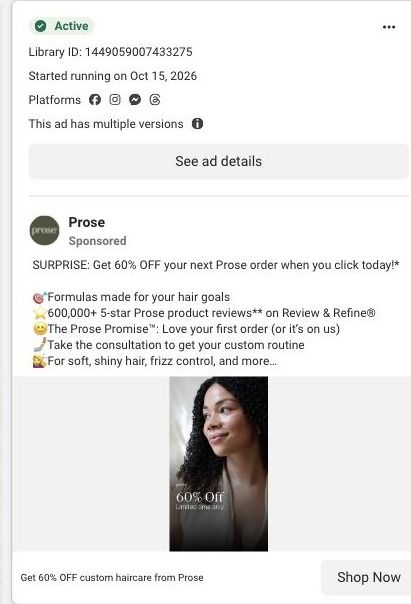
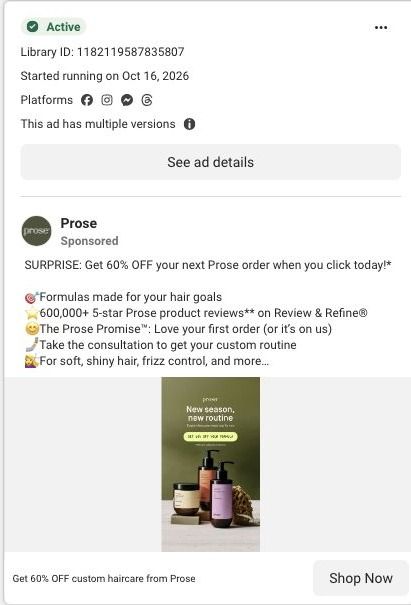
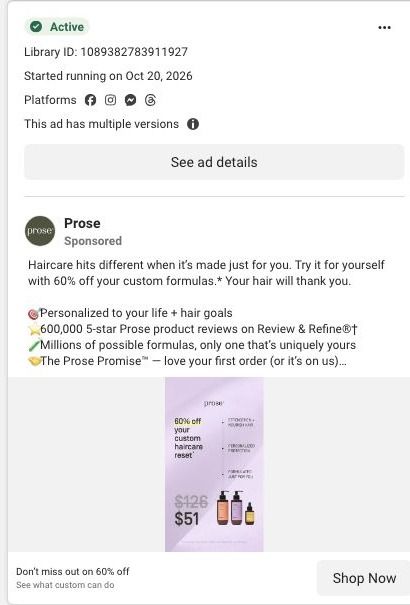
Prose · Referral sign-in gate
Public page captured October 22, 2026. Promotional sheets, chat, extension overlays and sticky cart bars were removed from the static reference; page layout and copy were preserved. No account, personal, health or payment details were supplied. Quiz captures show the observed entry screen, not the complete consultation. The referral offer redirected to a sign-in gate in the observed browser.
Get 60% OFF custom haircare from Prose
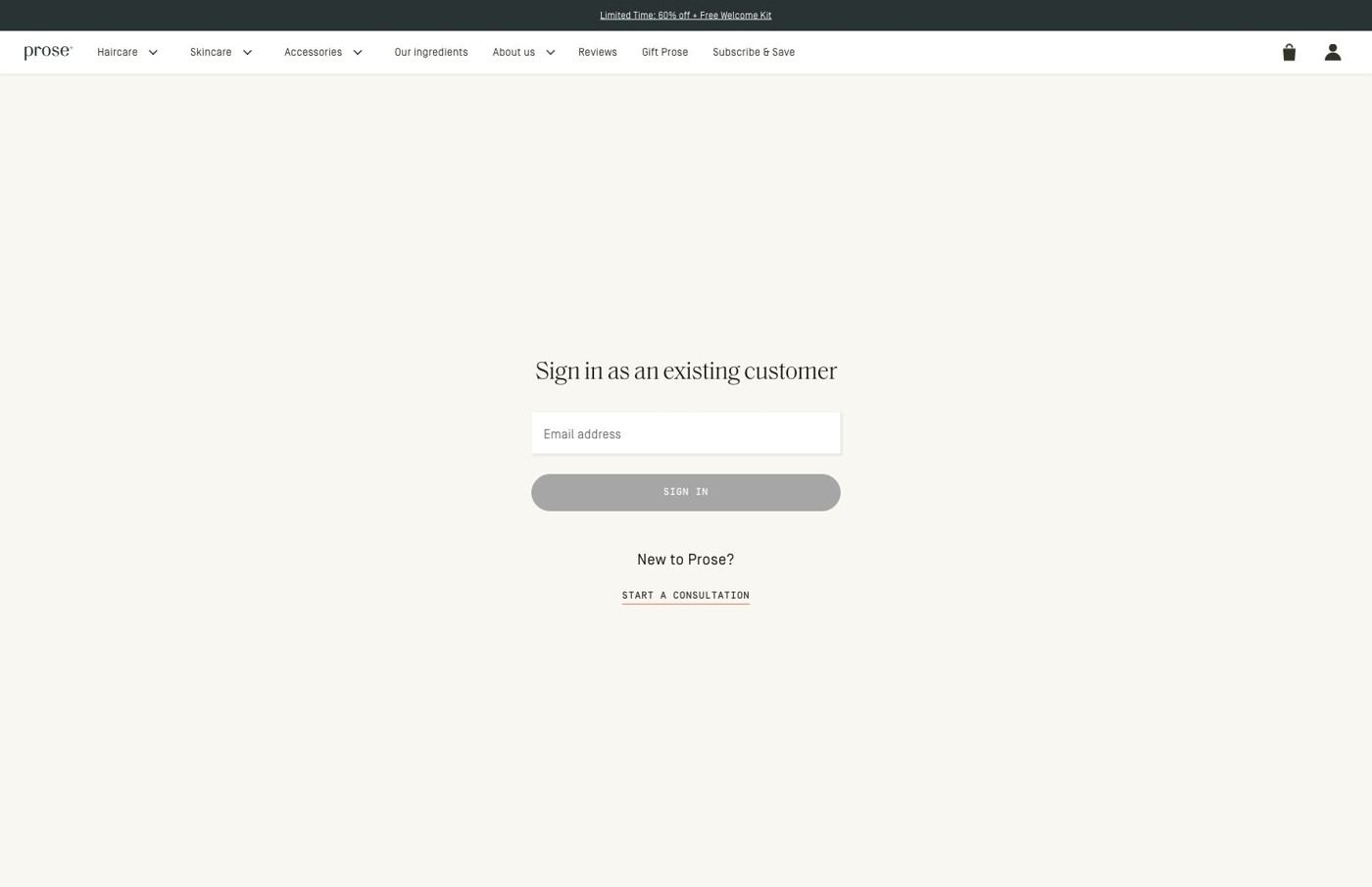
Visual reference: Why I stopped generic shampoo for gray hair. The observed referral/redeem links carry a public referral code and checkout next step. In the connected browser they redirected to the existing-customer sign-in screen. This is a captured gate, not a completed checkout or a public sales page. Compare the creative with the destination and explore the other ads sharing this route.
- Brand
- Prose
- Observed offer
- Advertised custom haircare offer; subscription and gift conditions apply
- Creative angle
- Personal results
- Page type
- Sign-in gate
- Ad format
- Video · 1:06
- Listed start date
- Sep 29, 2026
- Captured
- Oct 22, 2026
- Library ID
- 1363906405563558
- Destination
- prose.com
Selected for its design and offer structure. Ad performance isn’t available in this collection.
What this ad does well
The hook calls out a habit (generic shampoo) for a specific reader (someone with gray hair), and the first lines name what that reader has noticed: texture changed, shine gone, and everyone telling her that's just what happens. That last line is the emotional center, because it gives the viewer permission to want more from her hair. The proof is shown rather than only spoken: the 600,000+ reviews claim with Review & Refine and customer quotes on screen, then real quiz questions about how often you wash and how dense your hair is, so the effort is visible before anyone clicks. It closes on a clear instruction to take the quiz.
What's missing
The hook promises a gray-hair story, but the first frame is a shampoo pour with no gray hair in it, so the person this is written for doesn't see herself until later. At 66 seconds it also runs long for the amount of new information, and the second half lists results in general terms (softer, smoother, stronger) with no before & after credited on screen. Open on her gray hair under the same caption, add one before & after with a results-may-vary note, and cut it to well under a minute so the payoff arrives while people are still watching.
Beat by beat
- 0-3sCaption about why she stopped using generic shampoo for her gray hair, over pink shampoo poured on a mirror.
It calls out a specific habit and a specific reader in one line.
- 3-20sHer hair changed as she got older, texture and shine went, people said that's just what happens, and every product felt like a waste.
It names the frustration and the resignation the viewer already feels.
- 20-30sShe saw Prose all over her feed and found the 600,000+ five-star reviews claim, with review quotes on screen.
It uses social proof to explain why she gave it a try.
- 30-42sQuiz screens asking about wash frequency and hair density, then a custom line made for her.
It shows the mechanism and how small the first step is.
- 42-66sClaimed results (softer, smoother, stronger, shine, longer hair without chopping ends), telling friends, and take the quiz.
It stacks outcomes and ends with a direct instruction.
The offer
The primary text offers 60% off your next Prose order when you subscribe, with no commitment, plus the Prose Promise. The video doesn't mention a discount and closes on taking the quiz.
Where it sends people
The video's last instruction is to take the quiz, but the click lands on a sign-in gate, where the consultation is only a secondary link. Prose's redeem link carries a referral code labeled WINBACK, and in our capture, the link redirected to a sign-in page for existing customers: a promotion strip and store navigation, a centered sign-in heading with an email field, and a smaller link for new customers to start the consultation. On the persona's ladder that's below a homepage for a new viewer, and it breaks the one step the narrator asked people to take. Prose sends 17 of the 93 ads we captured to this same gate, so it's one fix with a wide reach: route cold traffic to the consultation welcome and keep sign-in for people who already have an account.
The page it sends people to: What happens when a Prose 60%-off referral ad lands on a sign-in
When we followed the referral links in Prose's 60%-off ads, they redirected to an existing-customer sign-in screen with an email field, a sign-in button and a secondary link for new customers into the consultation. It's the destination for 17 ads in the Fluid library, mostly offer-led statics plus creator videos.
How the page is built
- 01Promotion strip and navigation
The promotion strip and full store navigation sit above the form, keeping the offer visible and leaving the whole store one tap away.
- 02Sign-in form
A centered existing-customer heading, email field and sign-in button answer "how do I get to my order?" for people who already buy from Prose.
- 03New-customer link
A link into the consultation answers "what if I'm new?", and our capture stops at this gate.
The first fixes we would make
- The ads make a personal offer (one headline reads "Just for you: 60% off"), but the screen we landed on talks to existing customers and doesn't restate the discount in the form area. Repeat the 60% off in the heading, so the visitor knows the offer they clicked for is still waiting.
- New customers, who are the people a referral offer is usually trying to reach, get the secondary link instead of the main button. Make the new-customer path the primary action (something like "New to Prose? Start your consultation") and keep sign-in as the smaller option.
Read the full breakdown of this page
Three hooks you could test
- Call out the habit you're replacing. “Still using the shampoo you bought before your hair went gray?”
- Lead with the uncomfortable problem. “When did your hair stop shining?”
- Sell the outcome. “Gray, long and soft enough that people ask what you use.”
What to borrow for your brand
- Pair a habit callout with a specific reader in the hook (generic shampoo, gray hair) so the right viewer knows it's for her in one line.
- Name the line other people keep saying to your customer, the shrug that nothing can be done, and position the product as the reason she doesn't have to accept it.
- Show two or three real quiz questions on screen to make the first step feel small.
Transcript
Well, I stopped using generic shampoo for my gray hair. I always credited genetics for my beautiful hair, but as I got older, my hair completely changed. My texture changed. The shine was gone, and everyone said, that's just what happens. I thought there was nothing I could do. Every product felt like a waste of time. So when I saw everyone on my feed, talking about pros, I knew I had to check it out, I did some research and found out they have over 600,000, 5 star product reviews. So I took their free hair quiz, and they really did an amazing job getting to know my specific hair type, needs and growth goals. And then just like that, they created a totally custom line of products just for me from the 1st wash. I understood why everyone is so thrilled with pros. My hair feels so much softer, smoother, and stronger. And the shine is unreal. I've never been able to grow it this long without having to chop my dead ends. I couldn't be happier with these results. I've been telling all my friends, and now they all love pros too. If you've been on the fence about trying pros. This is your sign. Go take this quiz right now. Trust me, your hair will thank you.
Text on screen
- Why I stopped using generic
- shampoo for my gray hair
- I always credited genetics
- for my beautiful hair
- But as I got older,
- my hair completely changed
- My texture changed
- The shine was gone
- And everyone said,
- "That's just what happens"
- I thought there was
- nothing I could do
- Every product felt
- like a waste of time
- so when I saw everyone on my
- feed talking about Prose
- I knew I had
- to check it out
- Custom
- Shampoo
- FOR
- Jenie
- prose
- I did some research
- and found out
- III. How you live
- Your Male lives with you day-in and day-out, and is
- affected by your actual environmant and routing Be
- hones, bels, because your hair never let
- 600,000+ 5-star
- Prose product reviews*
- on Review & Refine®
- "Thank you for making
- such an awesome product!!!"
- www.prose.com/reviews
- "Best shampoo + conditioner
- I've ever used!"
- "I can't get enough
- of this stuff!
- 600,000 + 5-star
One of 93 Prose ads in the Fluid Inspiration Library, captured from the Meta Ad Library on Oct 22, 2026. We record that an ad ran publicly, not how it performed.