How Midi Health sells online HRT with one patch photo
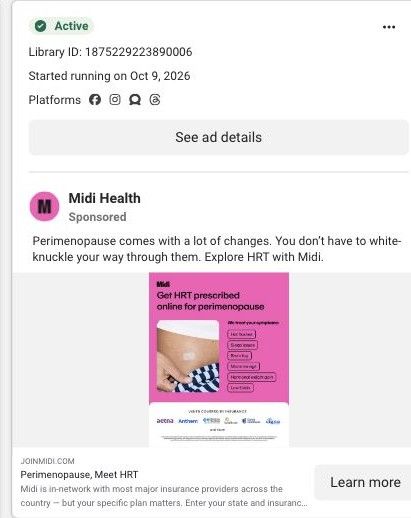
A static image Midi Health ran on Meta from Oct 9, 2026. On hot pink, Get HRT prescribed online for perimenopause sits over a photo of a patch on a hip and six symptom chips, from hot flashes to low libido, with insurer logos below. Headlined Perimenopause, Meet HRT, it links to the hormone therapy page.

Native Meta creative and exact outbound link observed October 22, 2026. Redirects were followed to the captured public destination. Broader women’s HRT and longevity care; this record is not classified as peptide-specific. Advertiser claims are source material; activity does not establish performance. No personal, health or payment details were entered.

Perimenopause, Meet HRT
An audience-focused care page connects a clear opening with treatment context, the clinician-led process, supporting information and a visit entry. Compare the creative with the destination and explore the other ads sharing this route.
- Brand
- Midi Health
- Observed offer
- Perimenopause, Meet HRT
- Creative angle
- Product education
- Page type
- Service landing
- Ad format
- Image
- Listed start date
- Oct 9, 2026
- Captured
- Oct 22, 2026
- Library ID
- 1875229223890006
- Destination
- joinmidi.com
Selected for its design and offer structure. Ad performance isn’t available in this collection.
What this ad does well
The patch photo makes the product the whole scene: a small rectangle on skin shows what HRT actually looks like, which takes the mystery out of it. We treat your symptoms: followed by six chips (hot flashes, sleep issues, brain fog, mood swings, hormonal weight gain, low libido) lets each viewer find her own reason in a glance. The copy is short and warm (you don't have to white-knuckle your way through them), and the headline, Perimenopause, Meet HRT, introduces the two like a match. The insurer strip handles the cost question without a word of copy.
What's missing
There's no proof in the ad beyond insurer logos, and no detail on what a visit involves. The link description promises a state and insurance carrier check, but the hormone therapy page it lands on doesn't have one, so that promise breaks at the click. If you make one like this, either send the ad to a page with the coverage checker or change the description to what the page offers (a covered first visit, no referral needed), and add a one-line patient quote under the chips.
Beat by beat
- ImageMidi and Get HRT prescribed online for perimenopause in large type on hot pink.
It states the service and the audience in one line.
- ImageA photo of a hand lowering a striped waistband to show a patch on the hip, beside We treat your symptoms: and six chips.
The patch shows what treatment looks like, and the chips let viewers find their own symptom.
- ImageVisits covered by insurance with Aetna, Anthem, Blue Cross Blue Shield, Health Net, UnitedHealthcare and Cigna logos, and prescription disclaimer text.
Logos answer the cost question at a glance.
- HeadlinePerimenopause, Meet HRT, with a description inviting you to enter your state and carrier to check coverage.
It frames the introduction and points to a coverage check.
The offer
No discount. Visits are framed as covered by insurance, and the description invites a coverage check by state and carrier.
Where it sends people
The ad lands on the hormone therapy page, a focused service landing page whose hero (Insurance-covered HRT) sits above the same patch photo, so the visual match is exact. Below, Most major insurance accepted. No referral needed., an HRT 101 section explaining forms and symptoms, safety, form and dosage cards, Start with a virtual visit., a price table (covered or $250 and $150 self-pay) and patient stories follow. The state and carrier checker the ad's description promises isn't on this page.
The page it sends people to: How Midi Health's hormone therapy page explains HRT in one scroll
Midi's hormone therapy page is a focused service landing page: an Insurance-covered HRT hero over a patch photo, a no-referral line, insurer logos, an HRT 101 explainer, safety, form and dosage cards, a virtual visit band, a price table, patient cards and FAQs. It's where 1 Midi ad in the library lands, the Perimenopause, Meet HRT patch static.
How the page is built
- 01Hero
Insurance-covered HRT with a line about safely determining if HRT is right for you and a Book now button answers what this is.
- 02Patch photo
A large photo of a patch on a hip answers what treatment looks like.
- 03No-referral line and logos
Most major insurance accepted. No referral needed. and insurer logos answer coverage.
- 04Trust band
Trusted by 500k+ women and evidence-based care answer whether others trust Midi.
- 05HRT 101
What is HRT?, how it works, its forms and the symptoms it's used for, with citations, answer what I'd actually be taking.
- 06Safety, form and dosage
Three cards under Personalized treatment, prescribed by an expert answer whether it's tailored and safe.
- 07Virtual visit band
Start with a virtual visit. says you'll leave with a plan even if HRT isn't right, answering what if it's not for me.
- 08Price table
First and returning visits, covered or $250 and $150 self-pay, with coverage notes answer cost.
- 09Patient cards and sources
Real women. Real results. photo cards and citations answer whether it worked for others.
- 10FAQs and closing CTA
Seven questions on benefits, safety, timing and hysterectomy, then Meet with an expert clinician today, answer the last doubts.
The first fixes we would make
- The ad's description invites people to enter their state and carrier to check coverage, but this page has no checker. Add the state and carrier selectors under the insurer logos, or point the ad at a page that has them.
- The ad lists six symptom chips, and the page only names symptoms inside the HRT 101 paragraph. Repeat the six chips under the hero so visitors see their reason again.
Read the full breakdown of this page
Three hooks you could test
- Make the product the whole scene. “This is what HRT looks like. A patch, prescribed online.”
- Call out the habit you're replacing. “You don't have to white-knuckle perimenopause anymore.”
- Lead with the uncomfortable problem. “Hot flashes, no sleep, and a brain that won't focus?”
What to borrow for your brand
- Show the actual treatment format (a patch on skin) as the hero image, so a medical product feels approachable.
- List symptoms as chips under a We treat your symptoms: line, so each viewer finds her reason quickly.
- Make sure the landing page has the tool your ad description promises, or rewrite the description.
One of 15 Midi Health ads in the Fluid Inspiration Library, captured from the Meta Ad Library on Oct 22, 2026. We record that an ad ran publicly, not how it performed.