

Lume DeodorantSponsored
Esc
How Lume asked one question to make backup deodorant feel wrong
A Lume creator video that ran on Meta from Oct 20, 2026. A woman digs through a cream handbag in her bathroom while captions list deodorant in your purse, car and desk, then asks why you're carrying it everywhere if it works. It pitches a gynecologist-created whole-body formula and 2 free items, linking to a starter-pack landing page.
Lume
11 creatives lead here1 / 11


Lume · Cream-leg hero variant
Public page captured October 22, 2026. Promotional sheets, chat, extension overlays and sticky cart bars were removed from the static reference; page layout and copy were preserved. No account, personal, health or payment details were supplied. Quiz captures show the observed entry screen, not the complete consultation.
Save over 30% + 2 FREE Items
Visual reference: Bag-to-bathroom · creator routine. The ad’s /test-1 route redirected to the cream-leg hero experiment, Variant B, during capture. Compare its hero with the primary Smell Better Naked page; both repeat the starter-pack offer and link to the kit builder. Compare the creative with the destination and explore the other ads sharing this route.
- Brand
- Lume
- Observed offer
- Starter-pack savings or product offer; original ad and destination terms apply
- Creative angle
- Creator stories
- Page type
- Starter-pack offer
- Ad format
- Video · 0:23
- Listed start date
- Oct 20, 2026
- Captured
- Oct 22, 2026
- Library ID
- 1734887417594169
- Destination
- get.lumedeodorant.com
Selected for its design and offer structure. Ad performance isn’t available in this collection.
What this ad does well
This is a sharper version of the backup-stick script Lume also ran with another creator. Instead of a statement, the turn is a question (if your deodorant works, why carry it everywhere?), and that puts the viewer in the position of answering it themselves. The purse-digging shot makes the habit physical, and a quick close-up of an ordinary deodorant's ingredient label sets up the contrast with Lume's skin-safe line. The voiceover then names the areas it's meant for in everyday words and closes on 2 free items, which the on-screen text repeats.
What's missing
The question is strong, but the ad answers it with claims instead of a demonstration. Nothing shows the creator going without the backup, and the 72-hour line is a caption rather than something you see. The ingredient-label close-up also goes by fast enough that a viewer can't tell what's wrong with it, so the contrast doesn't land. If you make one like this, slow down on one ingredient you're leaving out and say why, then end with the creator taking the spare out of her bag.
Beat by beat
- 0-5sThe creator digs through her handbag while captions list deodorant in your purse, car and desk.
It shows a habit most viewers recognize in themselves before saying anything about the product.
- 5-9sA close-up of an ordinary deodorant's ingredient panel, then a question about why you carry it everywhere.
The question makes the viewer answer for themselves, which is more persuasive than being told their product falls short.
- 9-16sShe says Lume was created by a gynecologist to control odor anywhere on your body, with areas listed on screen.
It introduces the alternative with a credibility point and widens where you'd use it.
- 16-23sThe close offers 2 free items with a first purchase.
It gives the viewer a specific reason to tap now.
The offer
The creator offers 2 free items with a first purchase, and the link headline adds over 30% off.
Where it sends people
The ad goes to a focused starter-pack landing page (the cream-application hero variant), a step above a homepage on the persona's ladder. It's one of 11 Lume ads in the Fluid library that land on this page. The ingredient mechanism section picks up the label contrast the ad hints at, and the starter-pack offer section with gift tiles delivers the 2 free items. The comparison table further down is where the why-carry-a-backup question really gets answered, so moving a short version of it up near the hero would make the page feel like the second half of this ad.
The page it sends people to: How Lume tests a new hero on its starter-pack landing page
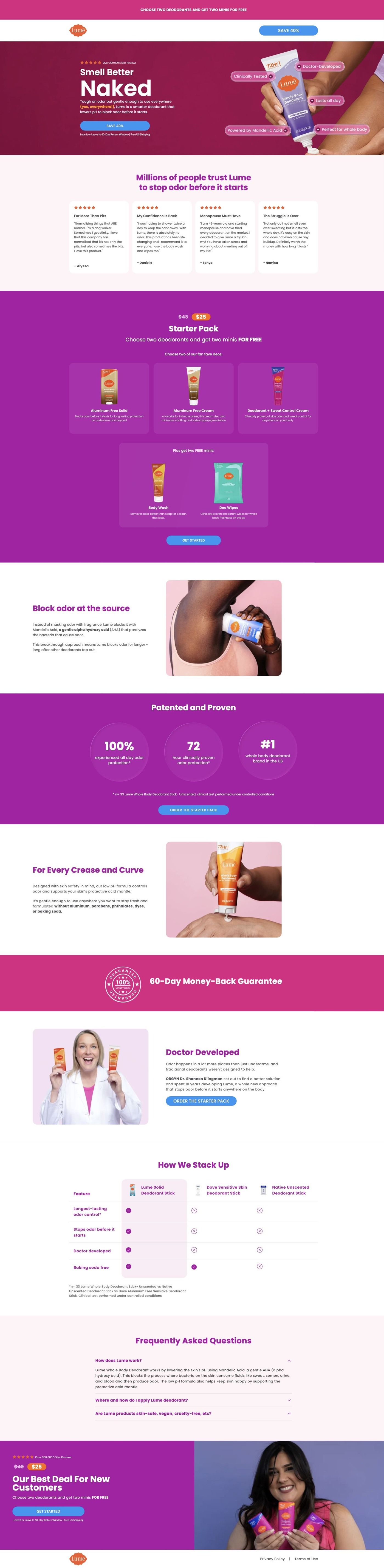
This is a variant of Lume's starter-pack landing page, served as Variant B of a cream-leg hero experiment when its ad route redirected during capture. It keeps the same reviews, offer, ingredient, proof, founder and comparison sequence with a new product-application hero. Eleven Lume ads in the Fluid library point here, mostly savings offers and creator stories.
How the page is built
- 01Announcement and header
A minimal logo header and announcement bar keep the visitor on the offer with no store navigation.
- 02Split hero with benefit labels
A product application image with benefit labels overlaid on the product answers "what does this do?" in a single look.
- 03Customer reviews
Review cards answer "do real customers like it?" before any price appears.
- 04Starter-pack offer
Product and gift tiles answer "what's in the pack and what's free?"
- 05Ingredient mechanism
An explanation with a supporting image answers "how is this supposed to work?" in Lume's terms.
- 06Proof metrics
Study metrics with a footnote answer "is there evidence behind the claims?"
- 07Whole-body use and founder
Usage reassurance and founder credibility, combined in one stretch, answer "can I use it everywhere, and who stands behind it?"
- 08Comparison table
Lume against alternatives answers "why switch from what I use now?"
- 09FAQ and final offer
The FAQ handles last objections and the offer repeats so the button follows the answers.
The first fixes we would make
- Every ad that lands here uses the saving over 30% plus two free items headline, but the variant hero leads with benefit labels on the product rather than the offer. Put the savings and the free items in the hero line or a badge on the image, so the first screen confirms what the ad promised.
- Like the main starter-pack page, this variant shows no guarantee in the blueprint. Add one inside the starter-pack panel and beside the final offer, where first-time buyers hesitate.
Read the full breakdown of this page
Three hooks you could test
- Call out the habit you're replacing. “If it actually lasted, why is there a spare in your bag?”
- Lead with the uncomfortable problem. “Checking yourself at 3pm isn't normal, it's a sign.”
- Show a specific moment of use. “One swipe before you leave, nothing in your purse.”
What to borrow for your brand
- Turn the habit callout into a question the viewer has to answer, so they reach the conclusion about their current product on their own.
- Show the competitor's ingredient label briefly as contrast, but hold on one ingredient long enough to explain why you left it out.
- Shoot the same script with several creators in different settings, so you get more ads from one idea without everyone saying it the same way.
Transcript
Deodorant in your purse, deodorant in your car, deodorant at your desk. If your deodorant works, why are you carrying it everywhere? Lumi was created by a gynecologist to control odor all day anywhere on your body. Under boobs, privates, feet, armpits? Anywhere. Click the link to get 2 free items with your 1st purchase.
Text on screen
- deodorant in your purse
- deodorant in your car
- COOR PROTECTION
- IN-IRRITANT
- INURNMES: FOR EXTERNAL USE ONEY DO NOT USE ON
- BROKEN SON STOP USE RASH OR FRITION COORS
- XEEP OUT OF REACH OF CHILDREN.
- INGREDIENTS: DIPROPYLENE GLYCEL, WATER POTA
- ULICER PROPYLENE GLYCOL, SODIUM STEARATE,
- FOLOKAMINE 1307, FRAORANCE PARRUM, STEARICACO,
- FININE, CIRAL CITRONELLOL, COUMARN, HENL
- DINAMAL, LIMONENE, LINALOOL
- deodorant at your desk
- 0076-
- if your deodorant
- why are you
- everywhere
- Made with skin-safe ingredients-
- by a gynecologist
- 72Hrl
- to Control Odor..OR CONTROL!
- Lume
- Whole Boe
- Deodord
- FOR PITS, PRIVATE BR
- anywhere on you body
- underboobs
- privates
- armpits
- click the link
- Whole Bod
- Deodorant
- Whole Body
- Doodorant
- 2 FREE items
- 105,
One of 100 Lume ads in the Fluid Inspiration Library, captured from the Meta Ad Library on Oct 22, 2026. We record that an ad ran publicly, not how it performed.