

Lume DeodorantSponsored
Esc
How Lume's numbered list ad pairs claims with an application shot
A 38-second Lume video that counts "9 reasons women are obsessing over Lume" over a sunlit close-up of a woman swiping the stick under her arm. The reasons run from limited-edition scents and a gynecologist creator to claimed 72-hour odor control and the starter pack's 2 free items plus free shipping. It links to Lume's starter-pack page.
Lume
60 creatives lead here1 / 60


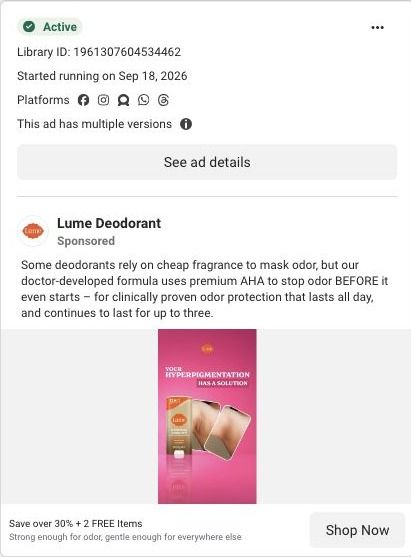
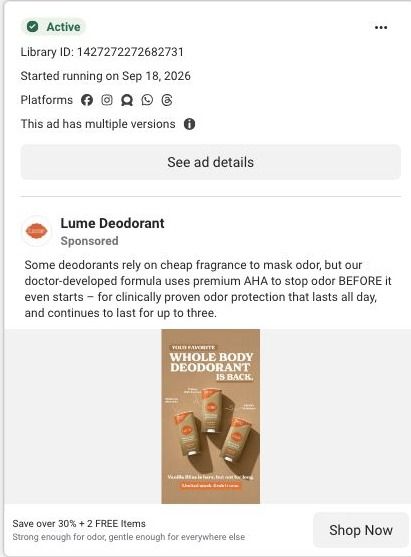
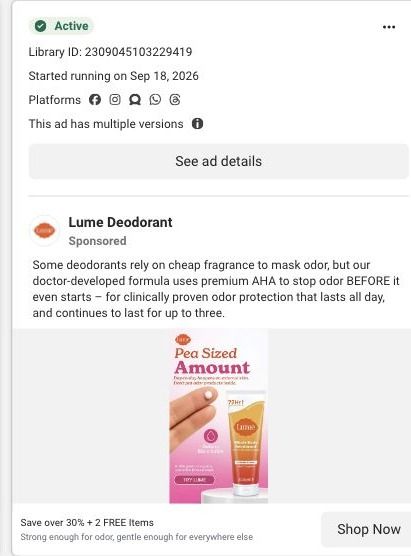


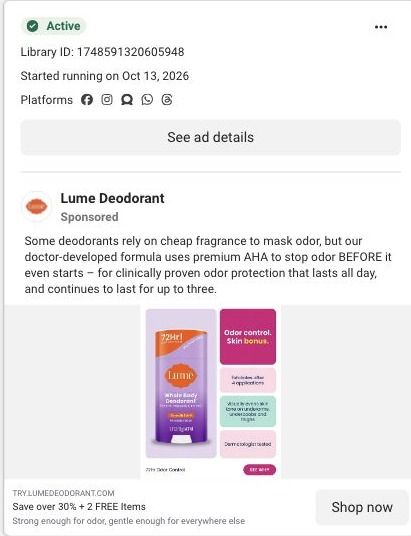
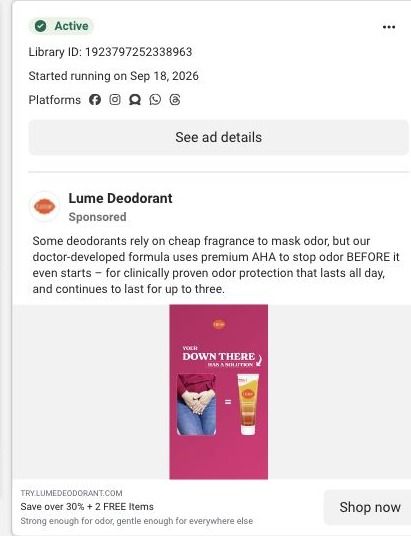

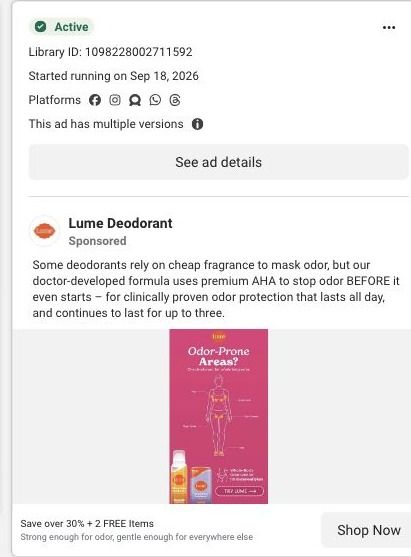

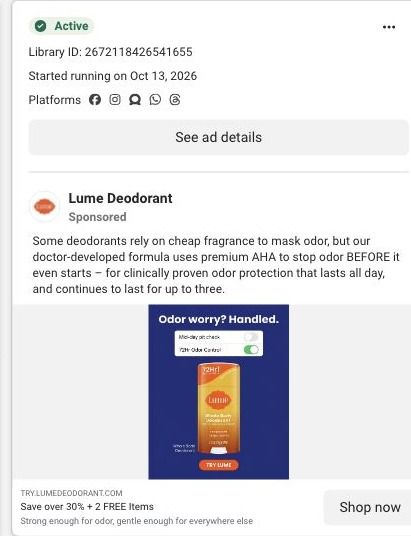


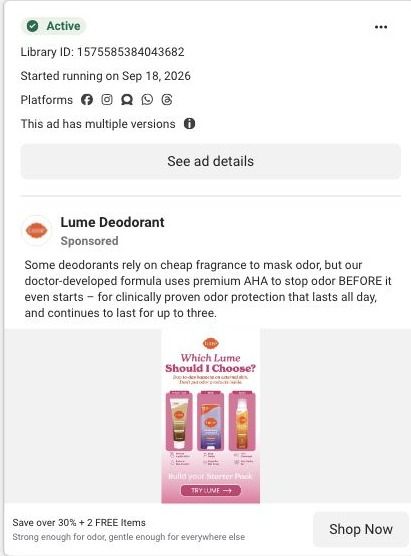

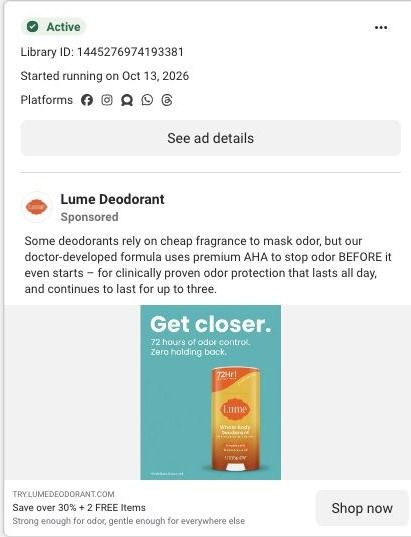
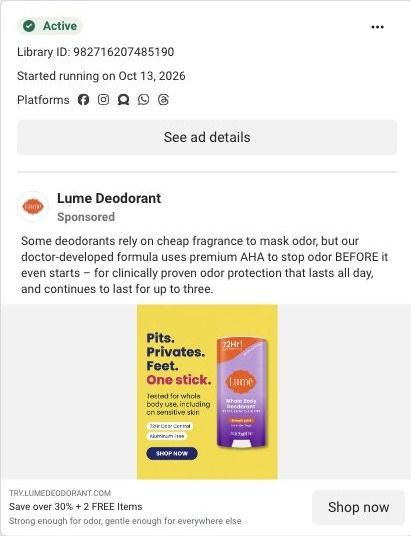
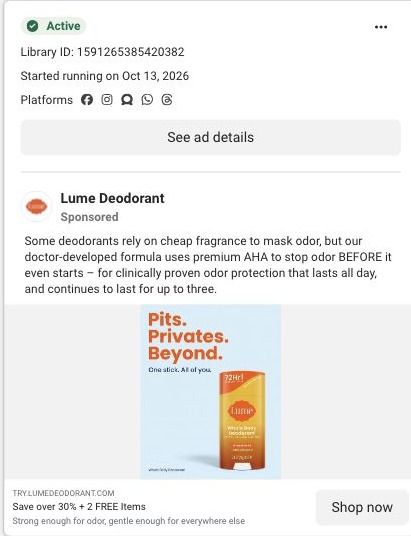
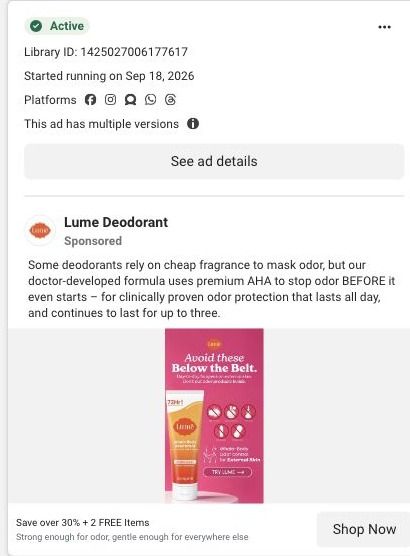
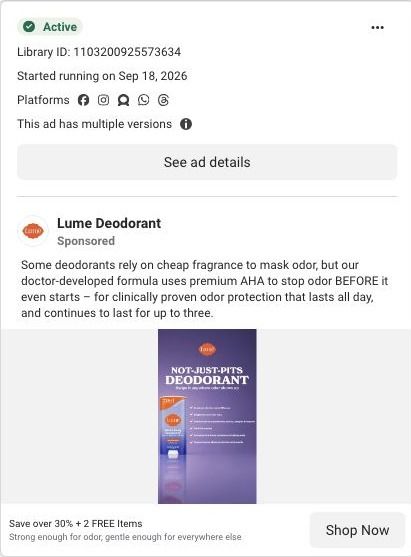

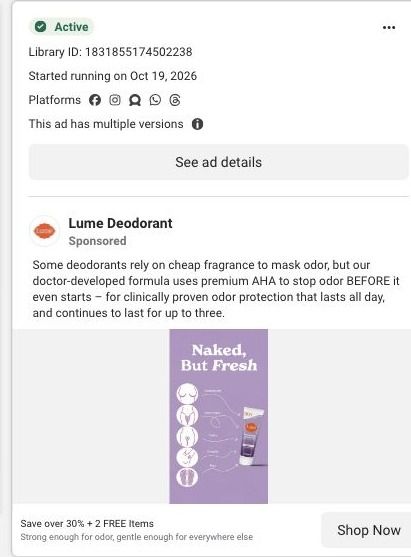
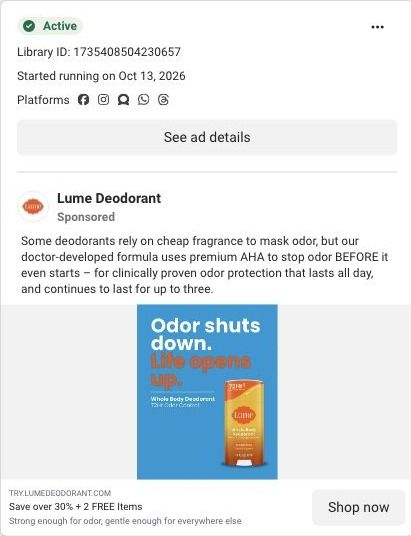
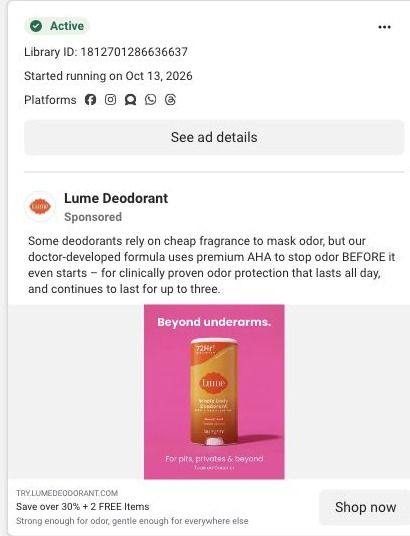
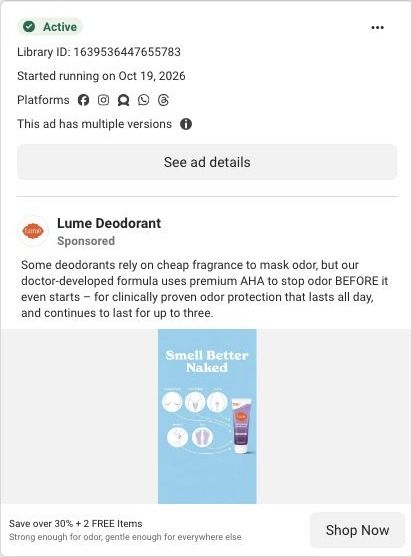

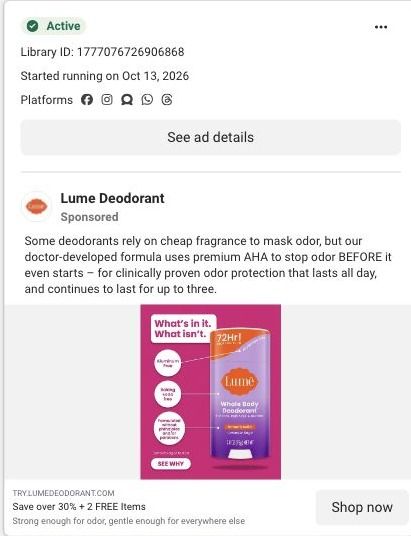
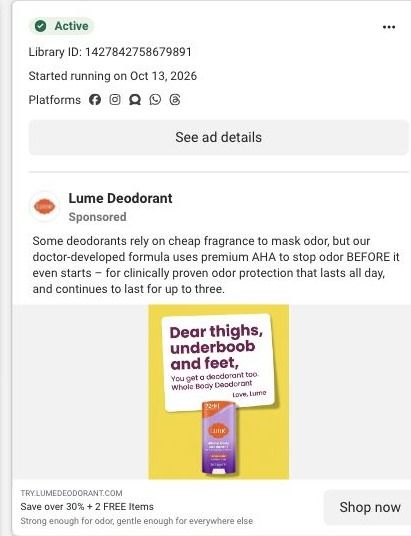
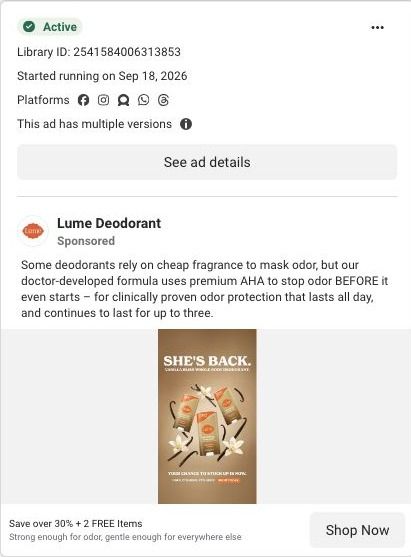





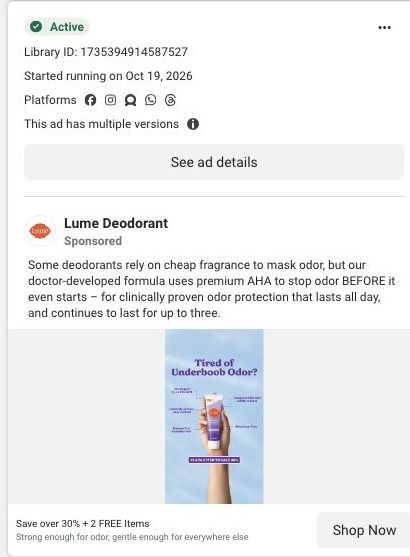


Lume · Smell Better Naked
Public page captured October 22, 2026. Promotional sheets, chat, extension overlays and sticky cart bars were removed from the static reference; page layout and copy were preserved. No account, personal, health or payment details were supplied. Quiz captures show the observed entry screen, not the complete consultation.
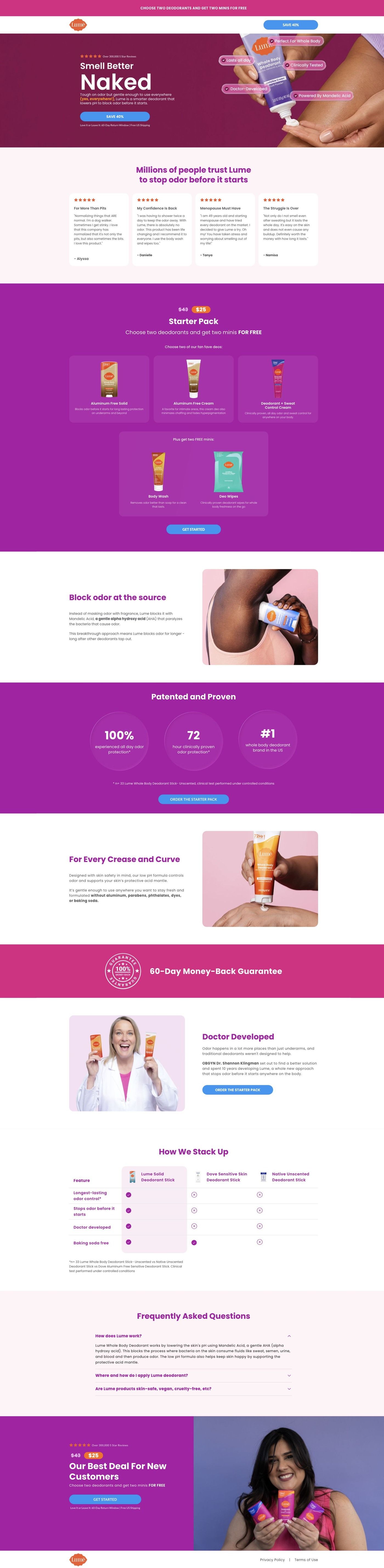
Save over 30% + 2 FREE Items
Visual reference: Underarm stick · application close-up. Creator stories, price objections and product stills converge on a long-form $25 starter-pack offer. Reviews, product education, founder credibility and a comparison table lead to the kit builder. Compare the creative with the destination and explore the other ads sharing this route.
- Brand
- Lume
- Observed offer
- Starter-pack savings or product offer; original ad and destination terms apply
- Creative angle
- Creator stories
- Page type
- Starter-pack offer
- Ad format
- Video · 0:38
- Listed start date
- Oct 19, 2026
- Captured
- Oct 22, 2026
- Library ID
- 1605923984620412
- Destination
- try.lumedeodorant.com
Selected for its design and offer structure. Ad performance isn’t available in this collection.
What this ad does well
This is the longer, numbered cut of Lume's 9-reasons script, and the numbers make it easier to follow than a fast list: you always know where you are and how much is left. The visuals show the product in use from the first frame, a clean sunlit shot of the orange whole body stick under the arm, so the claims are paired with an actual application. Each body area gets its own number (under the bust, around the vulva, tummy folds, feet), which gives each one a beat to land, and the list ends on the offer with a 'tap the link' instruction.
What's missing
The reasons are all claims and none is shown. The video says 'clinically proven' and 'created by a gynecologist' on screen, but there's no study figure, no doctor on camera and no customer voice to back them up. At 38 seconds, nine claims without proof start to feel like a feature list. If you make a numbered list like this, swap one of the reasons for a proof moment (a study number or a review quote on screen) and lead with the reason most tied to a problem the viewer has.
Beat by beat
- 0-4sCaption: '9 reasons women are obsessed with Lume', over a sunlit close-up of the orange stick going under the arm.
A numbered promise plus a product-in-use shot tells the viewer what this is and what to expect.
- 4-14sNumber one, the limited-edition scents (Spiced Sandalwood shown), and number two, created by a gynecologist.
Scent gives a reason to want it and the gynecologist claim gives a reason to trust it.
- 14-30sNumbers three to eight: claimed 72-hour odor control under the bust, around the vulva, in tummy folds, on feet, then aluminum and baking soda free and mandelic acid.
Giving each area its own number lets each use case land separately.
- 30-38sNumber nine: the starter pack includes 2 free items plus free shipping, then 'tap the link'.
The offer as the final number turns the list into a reason to click.
The offer
The voiceover says the starter pack includes 2 free items plus free shipping, and the headline reads 'Save over 30% + 2 FREE Items'.
Where it sends people
The ad goes to Lume's starter-pack landing page, a focused offer page rather than the homepage. The page backs up what the list only asserts: the ingredient mechanism section explains the highlighted ingredient, the proof section shows study metrics with a methodology footnote, and the founder story speaks to who created it. The starter-pack offer section's free-gift tiles match reason number nine. Because the page has the proof the video lacks, pulling one study metric into the ad would make the two feel like one argument.
The page it sends people to: How Lume's Smell Better Naked page sells a $25 starter pack
Lume's Smell Better Naked page is a long-form sales page for a $25 starter pack. It moves from a benefit hero through reviews, the offer, ingredient education, study proof, founder story and a comparison table, then repeats the offer. It's where 60 Lume ads in the Fluid library point, mostly creator stories, savings offers and product benefits.
How the page is built
- 01Announcement and header
A simple logo header with a savings CTA keeps the discount visible and gives the visitor nowhere else to go.
- 02Split hero
A reviews eyebrow, a large benefit headline, body copy and a CTA sit beside a product-use image, answering "what is this and why would I want it?"
- 03Customer stories
Review cards with stars and short quotes answer "do people like me actually use this?" before any price appears.
- 04Starter-pack offer
Price treatment, product choices, free-gift tiles and a CTA answer "what do I get and what does it cost?"
- 05Ingredient mechanism
An image and an explanation of a highlighted ingredient answer "how is this supposed to work?" in Lume's own terms.
- 06Study proof
Prominent study metrics with a methodology footnote answer "is there evidence behind the claim?"
- 07Whole-body use
An application illustration and reassurance copy answer "is it okay to use this beyond my underarms?"
- 08Founder story
A portrait and origin explanation with a CTA answer "who's behind this and why should I trust them?"
- 09Comparison table
A highlighted Lume column against alternatives answers "why this instead of what I use now?"
- 10FAQ and repeated offer
An accordion handles the last objections, then the starter-pack offer repeats above the policy footer so the decision and the button sit together.
The first fixes we would make
- Many of the ads that land here lead with a specific use ("For Boobs That Run Hot"), but the hero speaks to the whole body and the matching reassurance sits much further down in the whole-body section. Send each ad headline to a hero that repeats it (Lume already runs a hero variant on another URL) so the visitor sees their problem in the first screen.
- The blueprint shows no guarantee anywhere on this page, while Lume's sweat-control page has one. Put the guarantee inside the starter-pack panel and again by the final offer, since that's exactly where a first-time buyer hesitates.
Read the full breakdown of this page
Three hooks you could test
- Show a specific moment of use. “One swipe before I leave the house, and here are the reasons I don't think about it again.”
- Turn the benefit into a picture people get in a second. “From your armpits to your feet: one stick, numbered.”
- Sell the outcome. “Nine reasons, one result: you stop doing the sniff check.”
What to borrow for your brand
- Number each claim on screen so a long list stays easy to follow and viewers keep watching to reach the end.
- Run the list over a clean product-in-use shot rather than a talking head, so the claims are always paired with the product.
- Recut one script into a fast version and a numbered version to see which pace your audience sits through.
Transcript
Nine reasons women are obsessing over Lumi Deodorant. Number one, the limited edition scents smell incredible. Number two, it was created by a gynecologist. Number three, clinically proven 72 hour odor control under your boobs. Number four, around your Vulva. Number five, in your tummy folds. Number six, even on your feet. Number seven, it's aluminum and baking soda free. Number eight, it's powered by mandelic acid and pH optimized. And number nine, the starter pack includes 2 free items plus free shipping. Tap the link to get the offer.
Text on screen
- 9 reasons
- women are obsessed
- with Lume
- Whole Body
- Deodora
- Limited
- Lume
- Deodorant
- For Pits, Privates & Beyond
- Edition
- Scent
- Spiced
- Sandalwood
- NET WT 2.65 OZ (75g)
- Limited edition
- smells incredible!
- 72 Hour
- Odor Control
- Aluminum Free
- Deodorant™
- in Kingman,/
- Obstetricia/
- Created by
- gynecologist
- Obstetrician
- Created
- Clinically proven
- 72hrs odor control
- Also around
- your Vulva
- And your
- tummy
- folds
- Even on your
- feet
- Lunk
- Choie Body
- FOR FITS.
- Deodorani
- Aluminum and
One of 100 Lume ads in the Fluid Inspiration Library, captured from the Meta Ad Library on Oct 22, 2026. We record that an ad ran publicly, not how it performed.