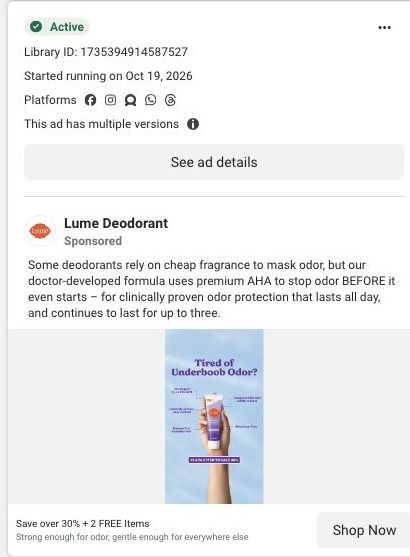
What this ad does well
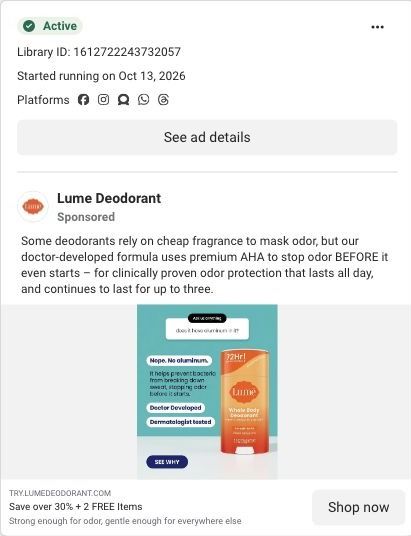
The question-sticker format feels native to Instagram stories, so the ad looks like a conversation rather than a promotion. More importantly, it answers an objection the shopper already has, in the shopper's words, and the answer is one confident word. The line after it explains how an aluminum-free product claims to stop odor (the ad says it keeps bacteria from breaking down sweat), and the two chips add credentials without crowding the layout. It's a clean template Lume could fill with any question.
What's missing
The literal question is about aluminum, but the worry behind it is usually whether an aluminum-free deodorant actually lasts. This ad answers the first question and only hints at the second, with the 72-hour claim showing up just on the pack. There's also no offer on the image. If you make one like this, add the duration claim as part of the answer (no aluminum, and here's how long it lasts) so the real doubt gets answered, then run the same template for the next few questions customers ask.
Beat by beat
- Question
A sticker labeled Ask us anything with the question does it have aluminum in it?The format looks like a real customer question, which feels native and trustworthy.
- Answer
Nope. No aluminum. followed by a line about stopping bacteria from breaking down sweat.A one-word answer plus the mechanism handles the objection directly.
- Chips
Doctor Developed and Dermatologist tested labels, with a See Why button.They add credentials and invite the reader to learn more.
- Image
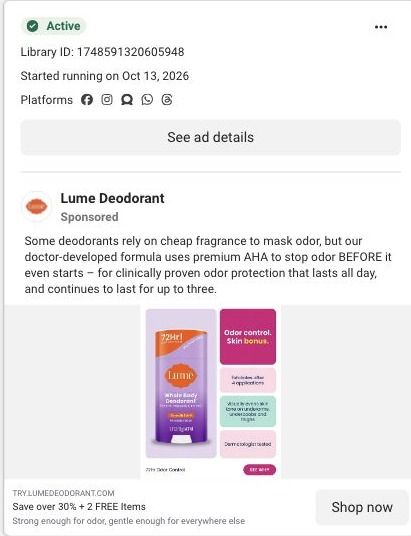
A Clean Tangerine stick on a teal and white set, with 72Hr! on the cap.The pack carries the duration claim the copy doesn't state.
The offer
The link headline offers Save over 30% + 2 FREE Items with a Shop now button. The image's button says See Why.
Where it sends people
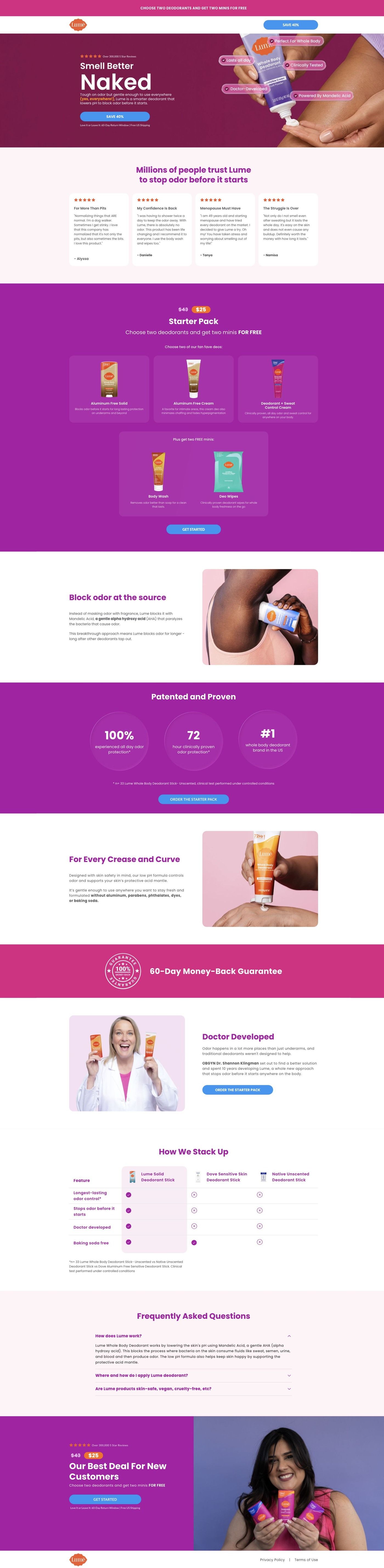
The ad sends people to Lume's long-form starter-pack page, a focused landing page rather than a homepage. The FAQ accordion near the bottom is the natural continuation of an ask-us-anything ad, the ingredient mechanism section expands on how it works without aluminum, and the proof section with study metrics answers the how-long-does-it-last worry. The comparison table also puts the aluminum point against alternatives. All of those sit below reviews and the offer, so a visitor who tapped See Why waits for the answer the button promised.
The page it sends people to: How Lume's Smell Better Naked page sells a $25 starter pack
Lume's Smell Better Naked page is a long-form sales page for a $25 starter pack. It moves from a benefit hero through reviews, the offer, ingredient education, study proof, founder story and a comparison table, then repeats the offer. It's where 60 Lume ads in the Fluid library point, mostly creator stories, savings offers and product benefits.
How the page is built
- 01
Announcement and headerA simple logo header with a savings CTA keeps the discount visible and gives the visitor nowhere else to go.
- 02
Split heroA reviews eyebrow, a large benefit headline, body copy and a CTA sit beside a product-use image, answering "what is this and why would I want it?"
- 03
Customer storiesReview cards with stars and short quotes answer "do people like me actually use this?" before any price appears.
- 04
Starter-pack offerPrice treatment, product choices, free-gift tiles and a CTA answer "what do I get and what does it cost?"
- 05
Ingredient mechanismAn image and an explanation of a highlighted ingredient answer "how is this supposed to work?" in Lume's own terms.
- 06
Study proofProminent study metrics with a methodology footnote answer "is there evidence behind the claim?"
- 07
Whole-body useAn application illustration and reassurance copy answer "is it okay to use this beyond my underarms?"
- 08
Founder storyA portrait and origin explanation with a CTA answer "who's behind this and why should I trust them?"
- 09
Comparison tableA highlighted Lume column against alternatives answers "why this instead of what I use now?"
- 10
FAQ and repeated offerAn accordion handles the last objections, then the starter-pack offer repeats above the policy footer so the decision and the button sit together.
The first fixes we would make
- Many of the ads that land here lead with a specific use ("For Boobs That Run Hot"), but the hero speaks to the whole body and the matching reassurance sits much further down in the whole-body section. Send each ad headline to a hero that repeats it (Lume already runs a hero variant on another URL) so the visitor sees their problem in the first screen.
- The blueprint shows no guarantee anywhere on this page, while Lume's sweat-control page has one. Put the guarantee inside the starter-pack panel and again by the final offer, since that's exactly where a first-time buyer hesitates.
Read the full breakdown of this page
Three hooks you could test
- Call out the habit you're replacing. “You asked if it works without the stuff you're used to. Here's the answer.”
- Lead with the uncomfortable problem. “Worried the natural version won't last past lunch? Fair question.”
- Make the product the whole scene. “Ask us anything about this bottle. We'll answer on the label.”
What to borrow for your brand
- Use a question-sticker layout to answer a real customer objection in the customer's own words, then give a one-word answer.
- Answer the worry behind the question too, not only the literal question.
- Turn the format into a series so each ad handles a different objection with the same template.
One of 100 Lume ads in the Fluid Inspiration Library, captured from the Meta Ad Library on Oct 22, 2026. We record that an ad ran publicly, not how it performed.