

Blokes Modern Men's HealthSponsored
Esc
How Blokes uses the “testosterone trap” to explain free T
A 64-second split-screen creator explainer for Blokes Modern Men’s Health. A creator talks to camera above gym footage of himself, explaining SHBG and why a normal total testosterone result might hide low free testosterone. He then describes Blokes panels, a 30-60 minute clinician visit, no membership fee and HSA/FSA eligibility. It links to the Blokes lab landing page.
Joi + Blokes
8 creatives lead here1 / 8
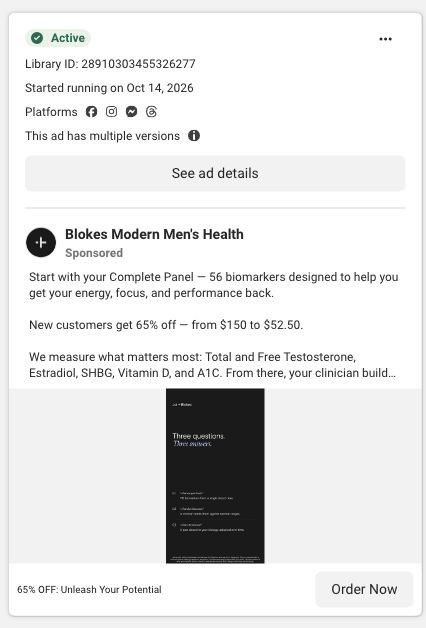
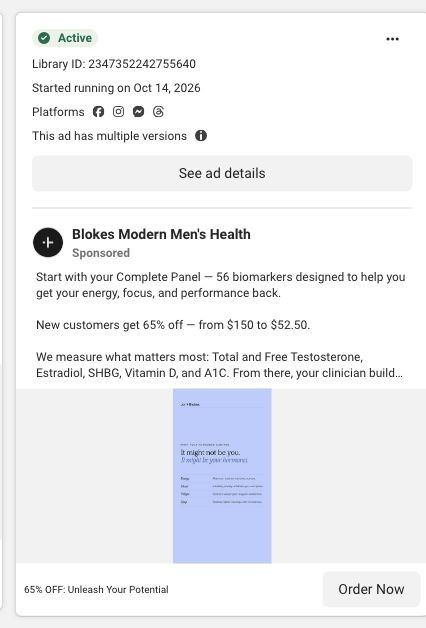
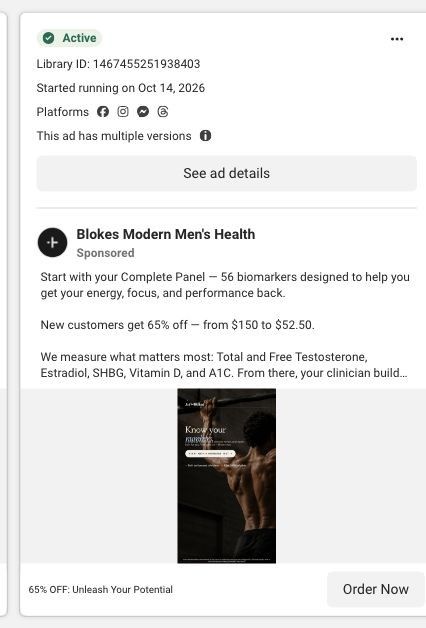


Men’s lab testing · consultation entry
Native Meta creative and exact outbound link observed October 22, 2026. Redirects were followed to the captured public destination. These ads promote diagnostic testing and hormone care; no peptide-specific active creative was observed in the sampled libraries. Advertiser claims are source material; activity does not establish performance. No personal, health or payment details were entered.
65% OFF: Unleash Your Potential
A focused lab-testing page pairs a direct entry offer with testing details, care steps and supporting information. Compare the creative with the destination and explore the other ads sharing this route.
- Brand
- Joi + Blokes
- Observed offer
- 65% OFF: Unleash Your Potential
- Creative angle
- Creator education
- Page type
- Dedicated offer
- Ad format
- Video · 1:04
- Listed start date
- Oct 14, 2026
- Captured
- Oct 22, 2026
- Library ID
- 1081397814931404
- Destination
- joiandblokes.com
Selected for its design and offer structure. Ad performance isn’t available in this collection.
What this ad does well
The ad gives the viewer a new idea, which is rarer than it should be: a protein called SHBG can bind testosterone, so a normal total number might not tell the whole story. That makes the test feel necessary rather than optional, and it ties directly to the caption, which lists free testosterone and SHBG among the markers. The split screen (talking head above, training footage below) keeps the eye busy for a full minute. The closing line, “maybe you’re not broken, you’re just trapped,” mirrors Joi’s “not broken” copy on the women’s side.
What's missing
Some lines are bigger claims than the ad supports: the creator says “most doctors never even check it” and describes feeling sharper with drive back, all as his own account. There’s no price on screen, and once the viewer clicks, the page’s hero talks about 110 biomarkers but doesn’t mention SHBG or free testosterone near the top, so the idea that hooked them disappears. If you make one like this, add a price card and send it to a page section that names the exact markers the video explained.
Beat by beat
- 0-5sCaptions read “Watch what happens when you unlock trapped testosterone” over a split screen of the creator and his gym footage.
It promises a reveal and puts the audience’s world (training) on screen.
- 5-25sHe explains the “testosterone trap”: SHBG binds testosterone, so total T can look normal while free T is low.
It teaches a mechanism the viewer likely hasn’t heard, which makes testing feel necessary.
- 25-45sHe says Blokes panels include free T and SHBG and that a clinician spends 30 to 60 minutes building a protocol.
It connects the idea to the product and spells out what happens after the test.
- 45-64sHe mentions no membership fee and HSA/FSA eligibility, then closes on “you’re not broken, you’re just trapped.”
It removes cost objections and ends on a line that lifts blame off the viewer.
The offer
The caption offers 65% off, $150 down to $52.50 for the Complete Panel. The video mentions no membership fee and HSA/FSA eligibility but no price.
Where it sends people
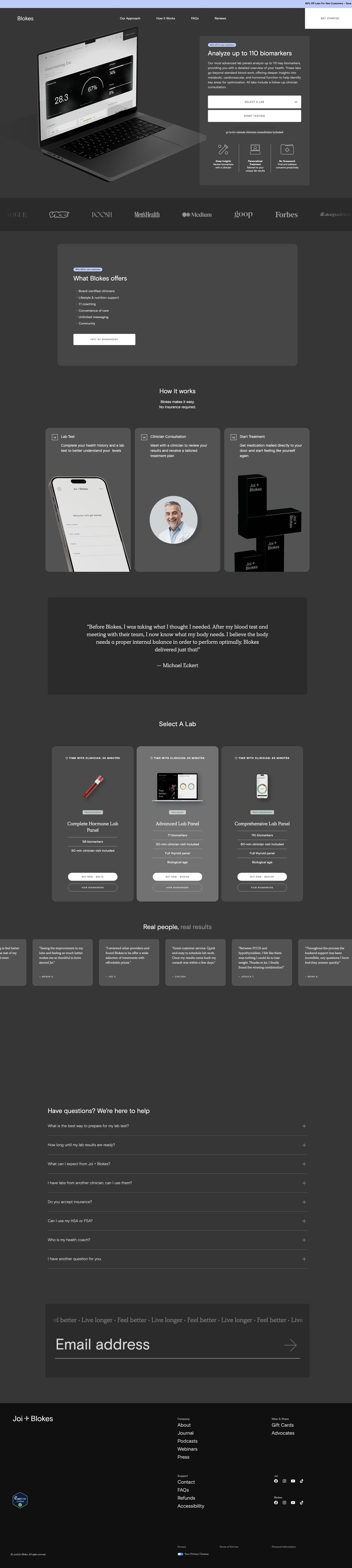
The ad lands on the Blokes lab landing page, a focused page that sits a rung above a product page. It confirms the clinician visit (30-60 minutes in the hero), the discount badge and the three-step process the creator describes. But the specific hook (SHBG and free testosterone) isn’t visible in the hero or the What Blokes offers list, and the Select A Lab cards only show biomarker counts. A short section naming the markers in each panel, with SHBG and free T called out, would keep the viewer’s new idea alive after the click.
The page it sends people to: How the Blokes men’s lab page sells hormone testing
The Blokes men’s lab-testing landing page leads with “Analyze up to 110 biomarkers” and a 65% new-customer badge, then covers what Blokes offers, a three-step process, a customer quote, three panels from $52.15, reviews and FAQs. 8 ads in the Fluid library send people here, from creator testimonials and a Stipe Miocic warning to typographic statics.
How the page is built
- 01Offer bar
It announces 65% off labs for new customers, answering “is there a deal?”
- 02Lab-testing hero
Up to 110 biomarkers, the 65% badge, a lab selector and the clinician consultation answer “what is this and what do I get?”
- 03Press logos
Vogue, Vice, Men’s Health, Forbes, Esquire and others answer “has anyone heard of this?”
- 04What Blokes offers
A list of inclusions and a “Test my biomarkers” button answer “what comes with the test?”
- 05How it works
Lab test, clinician consultation and treatment answer “what’s the process?”
- 06Customer quote
Michael Eckert on learning what his body needs answers “has this worked for someone like me?”
- 07Select A Lab
Three badged panels at $52.15, $139.65 and $244.65 answer “which one should I buy?”
- 08Reviews carousel
Short quotes under “Real people, real results” add customer voices.
- 09FAQ
Questions on preparation, results timing, insurance and HSA/FSA answer the logistics.
- 10Email capture
A closing email field captures visitors who aren’t ready to buy.
The first fixes we would make
- The ads sending traffic here talk about free testosterone, SHBG and a “normal” result that wasn’t, but the page never names those markers near the top. Add a “What we measure” section after the hero that lists the testosterone markers in each panel.
- The reviews carousel includes quotes that mention Joi and PCOS, which speak to the women’s brand. Replace them with men’s reviews so the proof matches the reader.
Read the full breakdown of this page
Three hooks you could test
- Lead with the uncomfortable problem. “Your total testosterone came back normal. So why do you still feel flat?”
- Turn the benefit into a picture people get in a second. “Picture your testosterone locked in a box. Here’s the key.”
- Call out the habit you're replacing. “Stop settling for a basic test that skips free T.”
What to borrow for your brand
- Teach one mechanism your buyer hasn’t heard before, in plain words, so the product becomes the obvious next step.
- Use a split screen with the creator talking above and lifestyle footage below to hold attention through a longer explanation.
- Make sure the landing page names the same specific detail the ad taught, near the top.
Transcript
Watch what happens when you unlock trap testosterone. I fell down this rabbit hole called the testosterone trap. Basically, there's this protein called SHBG, and it binds to your testosterone and locks it up. So even if your total T looks normal on a basic test, Your free testosterone, the stuff your body can actually use might be in the gutter. And most doctors never even check it. That's where blokes comes in. They run panels of up to 110 plus biomarkers, including free T and SHBG. Then, if you like, an actual clinician spends 30 to 60 minutes walking you through what's going on and builds a real protocol around your laps. And honestly, you feel it, sharper, energy back, drive back. The difference is day and night. There's 0 membership fee. It's HSA and FSA eligible. So if you've been told you're fine, but you feel anything but, maybe you're not broken, you're just trapped. Go to joyandblows.com and unlock it today.
Text on screen
- Watch what
- happens when
- Corte
- you unlock
- trapped
- testosterone.
- Cottaio mater
- Including mages and video, ro
- ing Al, or may feature actors of mode
- chanced
- than roai pat
- I fell down
- this rabbit hole
- Certain materials, including images and video, may be generated of echanced
- using Al, or may feature actors or modelt rather than real patients
- called the
- testosterone trap.
- Certain materials, including images and video, may be generated of enhanced
- using Al, or may feature actors or models rather than real patients.
- Basically, there's this
- protein called
- SHBG and it
- binds to your
- -binds to your
- testosterone
- and locks it up.
- So even if
- your total T
- Lab results reflect biomarkers at the time of colection and are not a dagnosis.
- Discuss results with a clinician before making treatment decisions.
- looks "normal"
- on a basic test,
- Lab resuits reflect biomarkers at the time of collection and are not a diagnotis.
- Lab resuits reflect biomarkers at the time of collection and are not a diagnosis.
- Discuss results with a cinician before making treatment decisions.
- your free
- Lab results reflect biomarkers at the time of collection and are not a diagnosis.
- the stuff
- your body can
- actually use
One of 18 Joi + Blokes ads in the Fluid Inspiration Library, captured from the Meta Ad Library on Oct 22, 2026. We record that an ad ran publicly, not how it performed.