
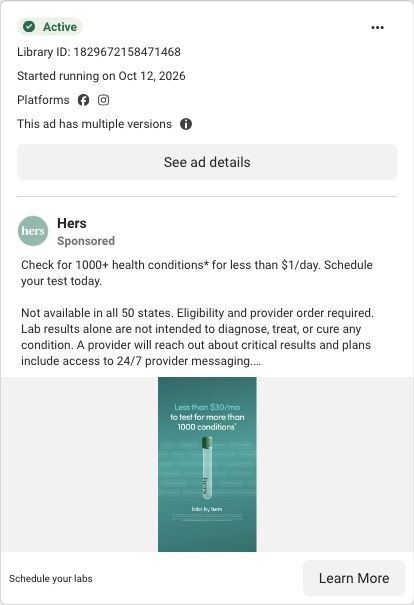
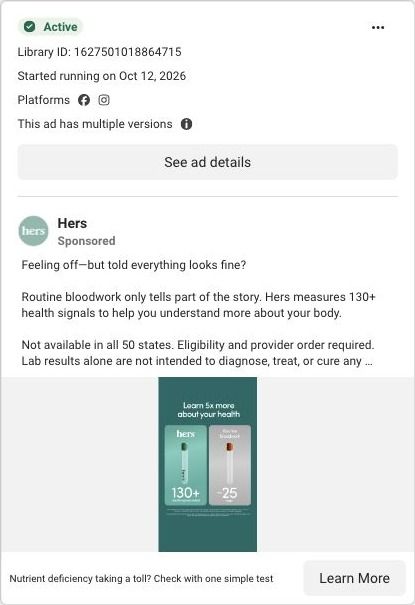
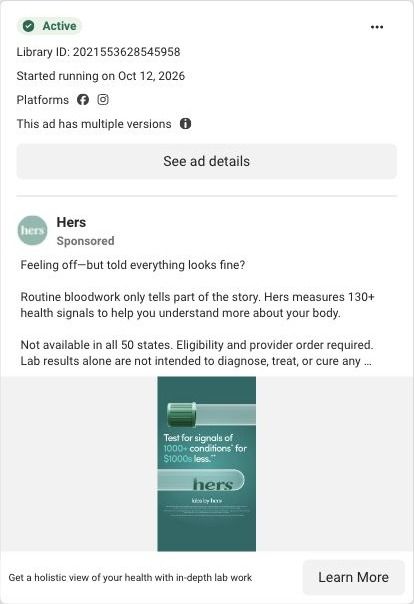
Learn 5x more about your health, plus get an Action Plan to help improve key areas. For less than $1/day: ✅ 130+ health signals tested ✅ Check for 1,000+ conditions* ✅Access to 24/7 provider messaging ✅Provider-led Action Plan Start testing with Labs by Hers. Not available in Hawaii. Eligibility and provider order required. Doctor developed insights and action plans include recommendations that encourage you to take action that may help improve your health. Lab results alone are not intended to diagnose, treat, or cure any condition. A provider will reach out about critical results and plans include access to 24/7 provider messaging. *Biomarkers track core biological pathways and while not diagnostic on their own, testing can help inform a provider about the underlying physiologic shifts that are associated with a very wide range of conditions.
How Hers Labs pitches lab testing to women in their 40s and 50s
A video ad from Hers that opens on an orange anatomy graphic with the caption "Nobody told me I can get checked for 1000+ health conditions." A voiceover aims at women in their 40s and 50s, then lists 130+ signals, an action plan and 24/7 provider messaging at $349 a year. It sends people to the Labs service page.
Public destination captured October 22, 2026. The reference retains the page layout and loaded imagery; shopping-extension UI is removed. Offers may change. No health answers were supplied.

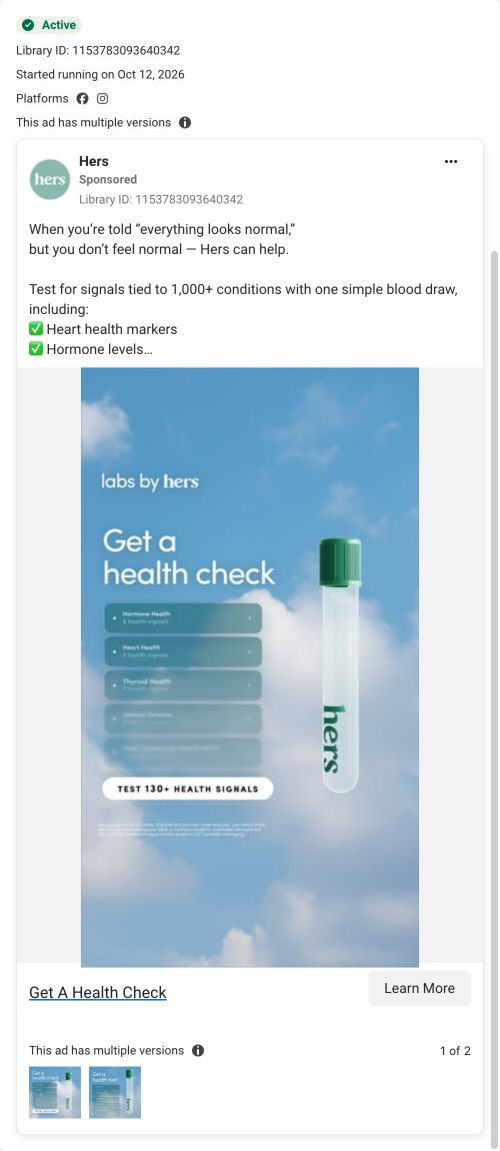
Get A Health Check
Visual reference: 1,000+ conditions: body visual. The long testing page explains health signals, an Action Plan and pricing. Its Start testing CTA goes directly to an Account → Profile → Checkout entry that asks for email. Compare the creative with the destination and explore the other ads sharing this route.
- Brand
- Hers
- Observed offer
- Labs testing advertised for less than $1/day; eligibility and provider order required
- Creative angle
- Education
- Page type
- Service landing
- Ad format
- Video · 0:52
- Listed start date
- Oct 12, 2026
- Captured
- Oct 22, 2026
- Library ID
- 28889613770670513
- Destination
- forhers.com
Selected for its design and offer structure. Ad performance isn’t available in this collection.
What this ad does well
The "nobody told me" opener works like a friend sharing something she just found out, and the glowing anatomy figure gives the eye somewhere to land while the caption does the talking. Hers narrows the audience early by naming the 40s and 50s, which is far more useful than "anyone who cares about health." The script then answers the question most people have after a lab test (what do these numbers mean?) by contrasting a bare reference range you'd have to Google with a doctor-developed action plan. It closes with a concrete price, $349 a year with no insurance required, so the under-$1-a-day line has real math behind it.
What's missing
The age callout is the sharpest idea here, but it arrives as a voiceover a few seconds in rather than in the opening caption, so the viewer it's meant for may scroll past first. The "1,000+ conditions" claim also needs its own footnote on screen, which competes with the hook. If you make one like this, put the audience in the first frame ("In your 40s? Your annual bloodwork may not cover this") and let the condition count come later as supporting detail. The ad would also benefit from one real-looking result to show what changes for the viewer.
Beat by beat
- 0-3sAn orange anatomy figure on black with a caption claiming checks for 1000+ health conditions for under a dollar a day, plus a biomarker footnote.
It frames the service as a surprising discovery and puts the price cue in the opening line.
- 3-12sThe voiceover asks "At this age?" and says changes in your 40s and 50s don't show up in basic bloodwork, over an actor portrayal.
It names the audience and gives a reason the service matters to them specifically.
- 12-30sCaptions cover 130+ signals tested per year and contrast a bare reference range with a doctor-developed action plan.
It explains what the customer receives and why it's more useful than a standard result.
- 30-42sA chat screen shows a question about B12 and a provider reply, alongside captions about medication if eligible and 24/7 messaging.
It makes ongoing provider access tangible with a believable example exchange.
- 42-52sThe voiceover says it used to be out of reach and now costs $349 a year with no insurance required.
It closes with a specific annual price that backs up the per-day framing.
The offer
The video states $349 a year with no insurance required, framed in the opening as less than a dollar a day; the copy notes eligibility and a provider order are required.
Where it sends people
It lands on the Labs by Hers service page, which 8 ads in the Fluid library send people to. The page is a focused service landing page rather than a homepage, so it's a step up the ladder, though not a quiz. It opens on a broad hero about testing for signals of many conditions, then a stat strip with markers tested, tests per year and cost per day, and later a comparison table against routine labwork. Every Start testing button goes straight to an account and checkout entry that asks for an email. The page carries this ad's claims (signals, cost per day, action plan, comparison with routine labwork), but nothing on it speaks to the 40s-and-50s audience the ad sets up.
The page it sends people to: How Hers explains provider-ordered lab testing on one long page
Hers's Labs page is a long service page for provider-ordered lab testing. It shows the service through app-style UI cards over photos, then stacks a stat strip, how it works, coverage, a comparison with routine labwork, experts, proof and FAQs, all ending in Start testing. 8 ads in the Fluid library send people here, including education, price-led and problem-led ads.
How the page is built
- 01Header
A logo, anchor links to what's tested, how it works, the action plan and screening, and a Log in link let visitors jump straight to their question.
- 02Hero
A full-bleed photo with a floating metric chip, a headline about testing for signals of many conditions and a small Start testing button set up the broad promise.
- 03Stat strip
Three short stats (markers tested, tests per year, cost per day) answer "how much do I get, and what does it cost?" before any explanation.
- 04How it works
Three numbered cards with UI mocks show booking, results and an action plan, answering "what actually happens?"
- 05Coverage grid
Eight tiles, one per body system, list marker names, answering "what's tested?" for visitors who want detail.
- 06Early-indicator split
A tall card lists condition names in large serif type beside an "out of range" phone card, showing the kinds of signals the page says the tests look for.
- 07Action plan
Category tabs (exercise, nutrition, sleep, habits) and a recommendation card answer "what do I do with my results?"
- 08Comparison table
The service is set against routine labwork across about eleven rows of checks, answering "why not just use my annual bloodwork?"
- 09Add-on screening
A teal panel with a body silhouette and floating chips introduces an optional screening, with three feature tiles on adding it, breadth and frequency.
- 10Experts carousel
Doctor portraits with roles, specialties and short bios answer "who's behind this?"
- 11Bento proof grid
Tiles mix a customer-count stat, a satisfaction stat, provider follow-ups and in-app content, gathering the page's proof in one place.
- 12FAQ and closing hero
Six accordions cover who it's for, the process, the in-person visit, what's tested, video visits and insurance, before a dark closing photo with a results dashboard and a final Start testing button.
The first fixes we would make
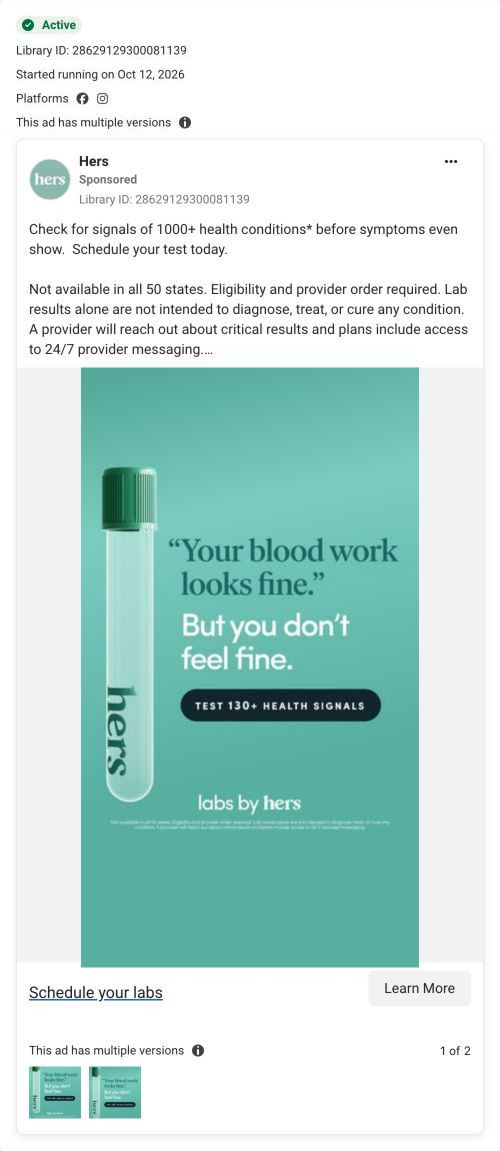
- The problem-led ad about nutrient deficiency lands on a hero about signals for many conditions, and the specific concern only shows up lower, in the coverage grid. Give that ad its own variant hero, or link it to the grid with the relevant body-system tile highlighted, so the visitor who clicked about one worry sees it answered first.
- The bento grid carries stats (a customer count and a satisfaction figure) but no customer voices about the experience itself. Add a few short member quotes about booking the draw and reading results, so the visitor hears from someone who's done it, not just a number.
Read the full breakdown of this page
Three hooks you could test
- Lead with the uncomfortable problem. “Nobody told me my yearly checkup was missing this much.”
- Sell the outcome. “Stop Googling your results. Get a plan built around them.”
- Turn the benefit into a picture people get in a second. “Show your test results as a simple dashboard: what's fine, what needs attention.”
What to borrow for your brand
- Open with a "nobody told me" line that frames your product as a discovery the viewer will want to pass on.
- Name the life stage you're speaking to in the script, so the right viewers stop and the rest self-select out.
- Contrast the confusing version of your category (a number you have to Google) with what your customer actually gets, so the value is concrete.
Transcript
Text on screen
- Nobody told me I can get checked for
- 1000+ health conditions for less than
- a dollar a day
- Biomarkers track core biological pathways, and while not
- diagnostic on their own, losting can help inform a
- provider about the underlying physiologic shifts that are
- associated with a very wide range of conditions.
- Biomarkers track care biological pathways, and while not
- diagnosfie on their own, testing can help inform a
- At this age?
- Actor Portrayal
- Because the stuff
- that starts
- shifting in your 40s
- and 50s
- doesn't show up
- in basic bloodwork.
- Labs by Hers,
- changed that.
- mmotion & Stress »
- tested per year.
- You don't just
- a reference range
- and have to Google
- whatever that means.
- Get expert guidance
- based on your results
- You get a
- doctor-developed
- action plan
- built around
- your results.
- And if you're
- eligible,
- Where to focus first?
- access to
- medication
- tailored
- to what your
- body actually
One of 125 Hers ads in the Fluid Inspiration Library, captured from the Meta Ad Library on Oct 22, 2026. We record that an ad ran publicly, not how it performed.