

GrazaSponsored
Esc
How Graza used a founder story to launch olive oil potato chips
A founder-style video from Graza: a man at a desk with a bag of chips explains why an olive oil company launched potato chips, how the chips are made, and the four flavors. Captions run throughout. There's no discount. The ad sends people to the chips product page, which ends in a Find in Store button.
Graza
4 creatives lead here1 / 4


Olive Oil Potato Chips
Cooked in 100% EVOO
The ad introduces four chip flavors while keeping the 100% extra-virgin-olive-oil ingredient story prominent. The CTA sends shoppers to the potato-chip product page. Compare the creative with the destination and explore the other ads sharing this route.
- Brand
- Graza
- Observed offer
- Graza Homestyle Potato Chips
- Creative angle
- Product benefits
- Page type
- Product page
- Ad format
- Video · 1:27
- Listed start date
- Aug 24, 2026
- Captured
- Oct 19, 2026
- Library ID
- 1711390340123334
- Destination
- graza.co
Selected for its design and offer structure. Ad performance isn’t available in this collection.
What this ad does well
The opening line is specific and a little absurd, which is exactly why it lands: “We grew 11 million pounds of potatoes to make this.” He then answers the question you'd be asking (why would an olive oil company make chips?) with a line that makes it sound obvious, since chips are all fried in oil anyway. The supply story is concrete, naming a North Dakota potato farm, oil from Spain and a chip maker that retrofitted its fryers, tanks and piping for extra virgin olive oil. Then he walks each flavor with a detail, like red wine vinegar in the salt and vinegar and a slow-burn pepper blend in the hot and sweet, so every flavor gets a reason to try it.
What's missing
There's no moment where anyone actually eats a chip and reacts, so the whole case rests on the process and not the taste. The video also never says where to buy, even though the page it links to sends people to a store locator. For a launch, that's the question viewers need answered right after “I want to try that.” If you make one like this, end on a bite and a one-line reaction, then a caption naming the stores that carry it, so the viewer leaves knowing where to go.
Beat by beat
- 0-3sHe opens on growing 11 million pounds of potatoes, with the chip bag on the desk.
A big, specific number earns attention and tells you this is a serious product launch.
- 3-15sHe asks what the most absurd thing for an olive oil company to launch would be, and answers potato chips.
Naming the odd idea out loud turns a strange brand extension into a story.
- 15-40sHe explains the North Dakota potatoes, oil from Spain and a chip maker that retrofitted its whole line for olive oil.
The supply details back the headline claim with specifics instead of adjectives.
- 40s-endHe walks through classic, salt and vinegar, hot and sweet, and zesty Caesar, with a detail for each.
Each flavor gets its own reason to buy, which gives people a pick before they reach the page.
Where it sends people
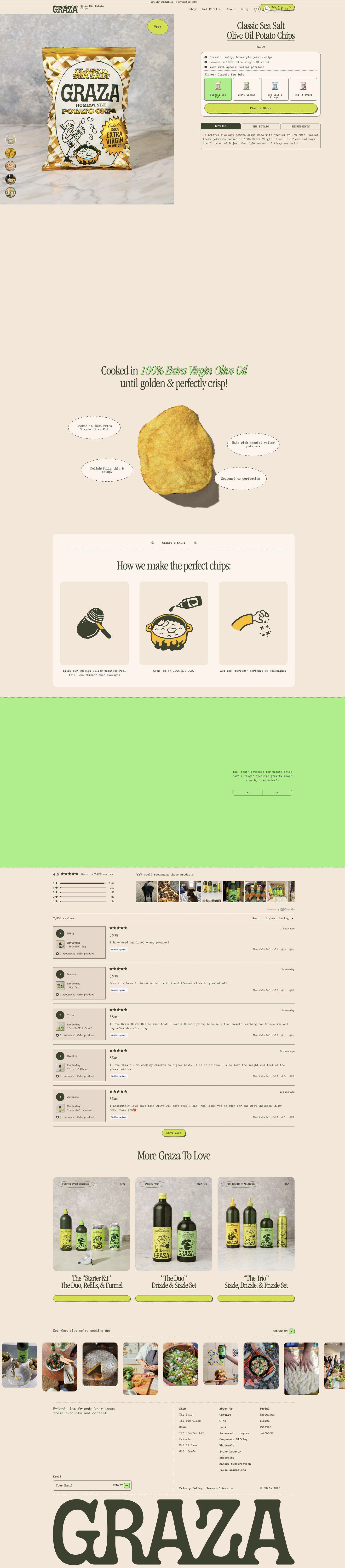
The ad points to the chips product page, a basic product page, not a focused landing page. The page does continue the founder's story with an annotated chip shot and a three-step slice, cook, season explainer, and it shows the flavor tiles he just walked through. But the button under those tiles says Find in Store, so the Shop Now promise turns into a store locator, and the reviews on the page are about Graza's other products, not the chips he just described.
The page it sends people to: How Graza built a product page for chips you can only buy in stores
Graza's product page for its olive oil potato chips, a retail-only snack. It pairs a buy box with flavor tiles and a Find in Store button with an annotated chip shot, a slice, cook, season explainer, reviews and bundle cross-sells. Four ads in the Fluid library send people here: a founder story, factory footage and creator taste tests.
How the page is built
- 01Announcement bar and header
A sitewide discount-applied-in-cart line and standard navigation set the context for shoppers browsing the store.
- 02Buy box
A pack shot with a New sticker, the product name and price, three bullets, flavor tiles and a full-width Find in Store button answer what it is, what flavors exist and where to get it.
- 03Details tabs
Tabs for details, the key raw ingredient and the ingredient list answer what's in it for shoppers who check labels.
- 04Blank area
A large empty block follows the buy box in the capture, likely content that didn't load.
- 05Annotated product shot
A headline and a single chip surrounded by four dashed-oval callouts answer what makes this chip different.
- 06Process explainer
Three illustrated steps, slice, cook and season, answer how it's made and back the olive oil claim.
- 07Brand fact band
A brand-color band with a single fact line and arrows adds one more reason to believe, though its image didn't load in the capture.
- 08Reviews widget
An average rating, customer photos and verified reviews answer whether people like Graza, though the reviews cover the brand's other products.
- 09Bundle cross-sell
Three bundle cards tagged by type of cook give chip visitors something they can buy online today.
- 10Social strip and footer
A photo row with Follow us, a newsletter field and an oversized wordmark close the page.
The first fixes we would make
- The reviews are for Graza's oils, not the chips, so the page has no proof about the product it's selling. Add chip-specific reviews or the creator taste-test clips from the ads right under the buy box.
- The ads say Shop now, but the page can only send people to a store locator. Change the ad CTA to match, or name the retailers next to the Find in Store button so visitors know where to go before they tap.
Read the full breakdown of this page
Three hooks you could test
- Lead with the uncomfortable problem. “Most chips are fried in oil you'd never cook with at home.”
- Call out the habit you're replacing. “If you won't cook with seed oil, why are you snacking on it?”
- Show a specific moment of use. “The bag I open the second the groceries hit the counter.”
What to borrow for your brand
- Open a founder video on one big, specific number from making the product, then answer the question a skeptic would ask next.
- Give every flavor or variant one concrete detail (an ingredient, a heat level) so viewers pick a favorite before they click.
- Name the real places in your supply chain to back an ingredient claim instead of describing it with adjectives.
Transcript
We grew 11 million pounds of potatoes to make this. We thought, what would be the most absurd thing for an olive oil company to launch? And we landed on potato chips. It's the most obvious thing, they're all fried in oil. So why not make an awesome potato chip, fried in our delicious extra virgin olive oil. So, we have 11 million pounds of potatoes and a farm in North Dakota. We have oil coming from our farms and our facilities in Spain, all coming to a ship producer that retrofitted their whole facility to work with extra virgin olive oil from the fryers to the storage tanks to the pipings, and we're able to make the same chip that we were buying from Spain here in America. We wanted to have some fun with the flavors. So this is the chip that you've already been buying, that you've known and loved. It's the perfect classic plain potato chip. Second flavor is salt and vinegar, which is everyone's favorite flavor, and we used red wine vinegar, which is really special and really different. Third flavor. It's my favorite. It's the hot and sweet. We use a Jack Hill pepper blend to make this flavor. And that's a slow burn. So, the last flavor, something that we want to have a lot of fun with, something different that no one's done before that we think Raza could do. And that's our zesty Caesar. This is gonna be an awesome flavor that people didn't know they wanted on a potato chip.
Text on screen
- We grew eleven millon bounds of
- potatoes,
- SRAZA
- HOMESTYLE
- We grew eleven million pounds of
- We thought, what Would bathe most
- We thought, what would betthe most
- absurd thing
- CRAZA
- for an olive oil company to launch?
- And we landed on potato
- chips.
- It's the most obvious thing, they re
- all fried in oil.
- It's the most obvious thing, they're
- So why not make an awesome potato
- chip
- fried in our delicious extra virgin
- olive oil?
- So we have eleven millio pounds of
- potatoes
- So we have eleven million pounds of
- and a farm in North Dakota.
- We have oil coming from our farus
- and our facilities la spain
- We have oil coming fronour farms
- and our facilities ta Spain;
- We have oil coming fronour arms
- and our facilities to Spati
- We have oil coming frontour farms
- and our facilities li Spaid
- all coming to a chip prodiger
- all coming to a chip producer
- that retrofitled their whole facility
- to work with extra Virgin olive oil.
- that retrofiled their whole facility
- to work with extra Virgih olive oil
- that retrofitted their whole facility
- to work with extra virgin olive oill
- From the friers, to the storage tanks,
One of 7 Graza ads in the Fluid Inspiration Library, captured from the Meta Ad Library on Oct 19, 2026. We record that an ad ran publicly, not how it performed.