How Cymbiotika opens an ad by telling you not to buy
A static from Cymbiotika that starts its copy with "Don't buy Cymbiotika supplements," then explains why pills and powders may not absorb and claims up to 3x better absorption for its liposomal packets. The image shows a Magnesium Complex packet beside a glass of water. Learn More opens an explainer on why most supplements don't work.

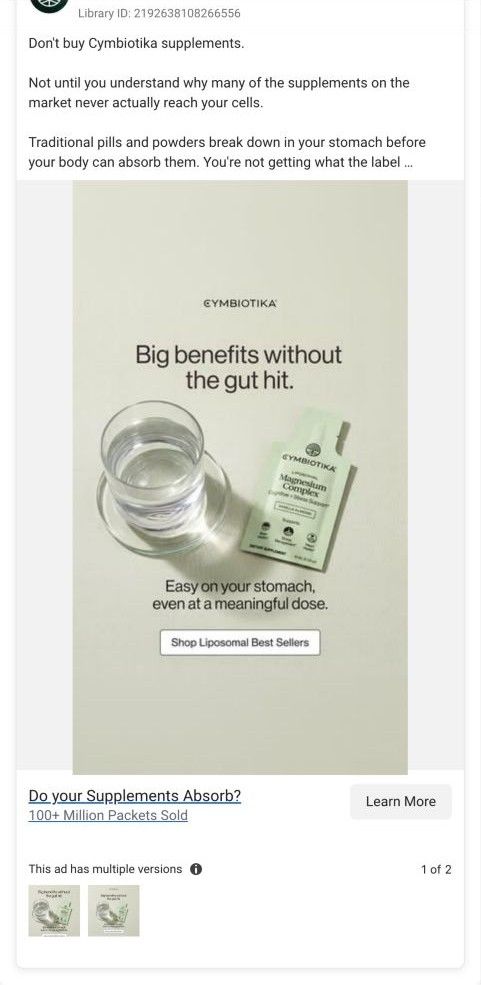
Creative, ad copy, and CTA link captured directly from Meta Ad Library on October 21, 2026. The linked destination was visited.

Do your Supplements Absorb?
Compare the education-led story with the purchase offer, ingredient explanations, and evidence presented on the page. Statements shown belong to the advertiser. Compare the creative with the destination and explore the other ads sharing this route.
- Brand
- Cymbiotika
- Observed offer
- Do your Supplements Absorb?
- Creative angle
- Education & problem awareness
- Page type
- Advertorial
- Ad format
- Image
- Listed start date
- Sep 17, 2026
- Captured
- Oct 21, 2026
- Library ID
- 2192638108266556
- Destination
- cymbiotika.com
Selected for its design and offer structure. Ad performance isn’t available in this collection.
What this ad does well
The reverse hook earns a second look, because a brand telling you not to buy its product is unexpected. The copy then pays it off in order: the problem (the copy claims pills break down before you absorb them), the mechanism (a protective lipid layer), the claim (up to 3x better absorption), and the proof the brand cites (100 million packets sold and 50,000+ five-star reviews). It ends by handing the decision back to the reader, which fits the opening. The image adds a second, plainer benefit, "Big benefits without the gut hit", for people who've had a supplement upset their stomach.
What's missing
The image and the copy are telling two different stories. The copy is about absorption, while the image is about being easy on your stomach and shows one Magnesium Complex packet, so the strongest idea in the text never shows up visually. The proof is also stated rather than shown. If you make one like this, put the absorption idea on the image (the landing page's own capsule-versus-liposome diagram would work as a static), and add a star rating or one short review so the numbers feel real.
Beat by beat
- ImageA Magnesium Complex packet lies next to a glass of water under "Big benefits without the gut hit," with a Shop Liposomal Best Sellers button drawn on the image.
It speaks to people who've had supplements upset their stomach and makes the packet look calm and easy to take.
- HeadlineThe link headline asks "Do your Supplements Absorb?" with "100+ Million Packets Sold" underneath.
The question names the doubt the copy is about to answer, and the sales figure gives a quick reason to trust the brand.
- CopyThe copy opens with "Don't buy Cymbiotika supplements," explains the absorption claim, and closes with packets sold and five-star review counts.
The reverse opening stops the scroll, and the problem-mechanism-proof order makes the claim easy to follow.
Where it sends people
The click goes to a focused explainer page, a better rung than the homepage or a basic product page, built around five reasons the brand gives for liposomal delivery. It picks up the ad well: the hero repeats the most-supplements-don't-work idea, a diagram shows a capsule breaking down versus a liposome reaching the bloodstream, and a numbered section covers being gentle on digestion, which matches the image. After an expert row and a comparison table, the page shows a bestseller buy box with Subscribe & Save and closes with a 60-day money-back guarantee. The 50,000+ reviews from the ad don't appear as a review section in our capture, and that's the proof to add.
The page it sends people to: How Cymbiotika explains liposomal absorption on one page
An explainer page from Cymbiotika arguing that most supplements don't work and giving five reasons the brand prefers liposomal delivery. It uses a capsule-versus-liposome diagram, numbered science rows, experts, a comparison table, a bestseller buy box, an FAQ and a risk-free close. One ad in the Fluid library sends people here, a static that opens with "Don't buy Cymbiotika supplements."
How the page is built
- 01Hero
A headline saying most supplements don't work and five reasons liposomal delivery does, with a Shop Liposomal Collection button, answers what this page claims.
- 02The Problem diagram
An illustration of a capsule breaking down versus a liposome reaching the bloodstream answers what goes wrong with standard supplements, in the brand's view.
- 03Five numbered reasons
Rows on absorption, nutrient shields, digestion, targeted delivery and clinical verification answer how the technology is said to work.
- 04Backed by Experts
Three portrait cards answer who stands behind the brand.
- 05The Cymbiotika Difference
A comparison table against conventional supplements answers why this format over a regular capsule.
- 06Our Liposomal Bestsellers
A buy box carousel opening on Vitamin D3 + K2 + CoQ10 with Subscribe & Save answers which product to start with.
- 07FAQ
Questions on liposomes, food versus supplements, timing and packaging answer the remaining doubts.
- 08Risk-free close
A lineup of four packets beside a 60-day money-back guarantee answers what you risk by trying.
The first fixes we would make
- There's no customer proof on the page in our capture, even though the ad that lands here cites 50,000+ five-star reviews. Add a review block after the comparison table so the science claims sit next to real customers.
- Two buy-box slides in the bestseller carousel render as blank panels in our capture. Make sure every slide loads, because a blank card right at the buying moment looks broken.
Read the full breakdown of this page
Three hooks you could test
- Call out the habit you're replacing. “Before you buy another bottle of capsules, read this.”
- Lead with the uncomfortable problem. “Your supplements might be upsetting your stomach for nothing.”
- Turn the benefit into a picture people get in a second. “Here's what's left of a capsule by the time it reaches you.”
What to borrow for your brand
- Open with a reverse instruction ("Don't buy us yet") only if the next lines pay it off with a clear reason to change your mind.
- Order long copy as problem, mechanism, claim, proof, so a skeptical reader can follow the argument step by step.
- Keep the image and the copy on the same idea; if the copy is about absorption, show absorption.
One of 12 Cymbiotika ads in the Fluid Inspiration Library, captured from the Meta Ad Library on Oct 21, 2026. We record that an ad ran publicly, not how it performed.