How The Absorption Company apologizes for your Netflix habit
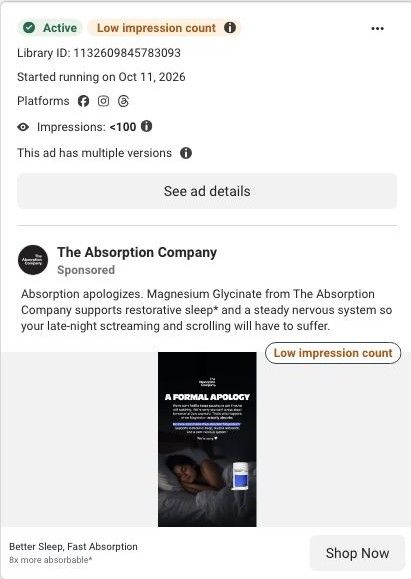
A static ad for The Absorption Company's Magnesium Glycinate, headlined "A Formal Apology" on black. It apologizes that Netflix keeps asking if you're still watching, highlights an 8x absorption claim in blue and shows a woman sleeping below. It ran on Meta from October 11, 2026 and links to an apology-themed advertorial.
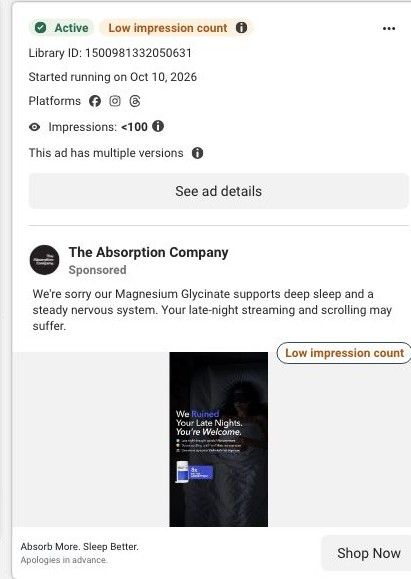
Active ad and exact outbound link observed in Meta Ad Library on October 22, 2026. This destination was captured with its public layout and styles on October 22. Offers and product selections may change. Selection reflects creative and page structure; performance is not available.

Better Sleep, Fast Absorption
A Formal Apology · black magnesium letter creative. A five-part editorial hook uses numbered stories and images to build toward the magnesium product, supporting details and purchase plans. Compare the creative with the destination and explore the other ads sharing this route.
- Brand
- The Absorption Company
- Observed offer
- Better Sleep, Fast Absorption
- Creative angle
- Humor / disruption
- Page type
- Advertorial
- Ad format
- Image
- Listed start date
- Oct 11, 2026
- Captured
- Oct 22, 2026
- Library ID
- 1132609845783093
- Destination
- absorbmore.com
Selected for its design and offer structure. Ad performance isn’t available in this collection.
What this ad does well
This version of the apology tightens the joke with a moment almost everyone recognizes: the streaming service asking if you're still watching because you fell asleep. The dark layout puts bold white "A FORMAL APOLOGY" type at the top and a calm sleeping woman at the bottom, so the before-and-after mood is built into the composition. The 8x absorption claim gets a blue highlight bar, which makes the one proof point the brightest thing on the page after the headline. Ending on "We're sorry" with a heart keeps the tone warm.
What's missing
Like the other apology static, it's text-heavy for a phone screen, and the claim is asterisked without saying who measured it or against what beyond "standard magnesium." There's no offer or reason to try it this week, and the primary text carries the same "sctreaming" typo. If you make one like this, cut to the Netflix line, the claim and the sign-off, and fix the copy. Adding one short customer apology from the landing page's review section would give the joke a real voice behind it.
Beat by beat
- Headline"A FORMAL APOLOGY" in heavy white capitals under The Absorption Company logo.
It promises a story and stands out against the black background.
- Letter bodyApologies that Netflix keeps pausing to ask if you're still watching and that you can't stress about tomorrow at 2am anymore.
Two specific, familiar moments make the benefit feel like the viewer's own night.
- Claim"8x more absorbable than standard Magnesium.*" highlighted in blue, followed by sleep, muscle and nervous-system benefits.
It pulls the proof point out of the joke so skimmers see it.
- ImageA woman sleeping peacefully in white sheets, with the Magnesium Glycinate bottle in the corner.
It shows the outcome the apology is joking about.
Where it sends people
The ad goes to an advertorial titled "We're Sorry In Advance" (five bad habits that won't survive your first week of magnesium), which is a focused landing page built for this exact campaign (one of four ads to this page in the library). It walks through numbered apologies (the 2 a.m. doomscroll, the 3 p.m. coffee, the 4 p.m. emotional snack, the nightcap), then the 8x absorption claim, "Why the magnesium in your medicine cabinet did nothing," a "Night 1 to Week 4" timeline, the purchase section ("Start the apology process"), reviews titled "Real people. Real apologies." and an FAQ. The ad's apology continues straight into the page's numbered apologies, and the "Night 1 to Week 4" section answers the obvious next question (how soon?). It's a strong message match, and the page has the reviews this static lacks.
The page it sends people to: How The Absorption Company sells magnesium with a playful listicle
A playful advertorial for The Absorption Company's magnesium glycinate, framed as an apology for five bad habits the brand claims won't survive your first week. Numbered habit stories lead into the absorption argument, a night-by-night timeline, the offer, reviews and FAQs. 4 Absorption Company ads in the Fluid library link here, mainly humor-led sleep and absorption statics.
How the page is built
- 01Sorry-in-advance hero
Frames the benefits as five habits the brand claims you'll lose, with a rating and a See Plans button, answering why keep reading.
- 02Five habit stories
Numbered stories on late-night scrolling, afternoon coffee, soreness, emotional snacking and the nightcap, answering what the product is claimed to change in a real day.
- 038x absorption
Introduces magnesium glycinate and its absorption claim, answering what the product is.
- 04Medicine cabinet enemy
Explains why the brand says the magnesium you already own did nothing, answering why this one is different.
- 05Night 1 to Week 4
A timeline of what the brand says to expect, answering when someone should notice a change.
- 06Offer
Presents the plans under an apology-themed headline, answering how to buy.
- 07Reviews
Shares customer reviews framed as apologies, answering what real buyers say.
- 08FAQ and close
Answers questions honestly and ends on a playful warning, answering the last doubts.
The first fixes we would make
- The byline is The Absorption Company Editorial, so the story has no person behind it. A named writer or customer (the brand does this well on its first-person WLP-1 story) would make the apologies feel lived rather than written by marketing.
- The ads lead with sleep, and the five habits cover sleep, energy, soreness, snacking and drinking. For sleep traffic, build a version that puts more weight on the night-time habits and moves the others lower.
Read the full breakdown of this page
Three hooks you could test
- Show a specific moment of use. “Sorry the streaming app has to ask if you're still watching. You're not.”
- Call out the habit you're replacing. “We apologize to your 2am worry session. It's been cancelled.”
- Turn the benefit into a picture people get in a second. “A paused episode on the TV and a sleeping viewer on the couch.”
What to borrow for your brand
- Find the one everyday moment that proves your benefit (like the streaming service asking if you're still watching) and build the ad around it.
- Highlight your single proof claim with a colored bar so it's the second thing people read after the headline.
- Run the same concept in a light and a dark layout to give the algorithm visibly different versions.
One of 188 The Absorption Company ads in the Fluid Inspiration Library, captured from the Meta Ad Library on Oct 22, 2026. We record that an ad ran publicly, not how it performed.